Manchu (1980): Robert Elegant

★★

The Imperial China Trilogy: Book I

Sometimes a book wears you down. You find yourself plodding away at it, determined to finish but finding that the number of remaining pages never seems to get any less. This, I’m afraid, was one of those books. A sweeping epic following the Jesuit mission in China in the mid 17th century, and told through the eyes of an ambitious young Englishman, it had scope to be very engaging. And it isn’t screamingly bad. It’s well-informed and detailed to a fault. But one is left with the powerful sense that 200 of its 634 pages could have been cut without any great loss to the story – in fact, probably to its advantage.

Continue reading

The Malice of Fortune (2012): Michael Ennis

★★

It’s 1502. Women are being murdered in the Romagna, and their deaths may hold the secret to a mystery that has plagued Pope Alexander VI: the brutal murder of his beloved son Juan, Duke of Gandia. Eager for revenge, he sends an agent north to find out more. The former courtesan Damiata arrives in the town of Imola, the headquarters of the Pope’s second son Cesare, with a powerful motivation to succeed: her infant son is being kept as a hostage at the Borgia court. Yet she isn’t the only one seeking the truth about these murders. Two others are also trying to identify the killer: one is the put-upon Florentine envoy, Niccolò Machiavelli; the other is Cesare’s engineer-general, the Tuscan polymath Leonardo da Vinci.

Continue reading

Ormisda (1730): George Frideric Handel and Friends

Ormisda - Maria Ostroukhova

★★★★

(Opera Settecento at St George’s, Hanover Square, 28 March 2017)

I’m running slightly behind on London Handel Festival reports, but didn’t want to forget this remarkable Orsmida, dominated by an absolutely brilliant performance from the talented mezzo Maria Ostroukhova. Like Catone and Elpidia in previous Festivals, Ormisda is a pasticcio, pulled together by Handel using arias from other composers’ operas. Not only did this enable him to fill one of the slots in the 1730 opera season, easing his workload a little, but it also introduced London audiences to some top arias from the Continent. Ormisda pulls together some very enjoyable music by Hasse, Orlandini, Vinci, Leo and Giacomelli, to tell a classic opera seria tale of dynastic politics in ancient Persia.

Continue reading

Flame in the Mist (2017): Renée Ahdieh

★★★

Since childhood, Hattori Mariko has always been regarded as a bit odd: too curious, too inventive for a girl of her high station. But even oddness can’t protect her from fate. As she travels by litter from her parents’ home towards the imperial city of Inako, she feels no different from any other well-born young woman, being forced into a marriage not of her choosing. Far away in Inako, in the enchanted precincts of Heian Castle, her betrothed waits: Minamoto Raiden, son of the emperor himself. But between the Hattori lands and Inako lies Jukai Forest, the haunt of ghosts, spirits and desperate men. And Mariko’s entourage, having entered the Forest, will never emerge.

Continue reading

Devices and Desires (2005): K.J. Parker

★★★★½

The Engineer Trilogy: Book I

With a long trip looming, I was hunting for the perfect book: something with engaging characters, brilliant world-building and a plot I could really get my teeth into. Fate must have been listening, because it brought me face to face with this unassuming-looking volume. For the last week, this has been my constant companion: a deliciously rich tale of intrigue and vengeance; love, loyalty and friendship; and clashing cultures. It’s shelved under fantasy because it takes place in a place not registered on any map of our world, but there isn’t a speck of magic in it. Anchored in technological experimentation and political strife, this is a superb story of human ambition – and how one small act can ripple out to bring down civilisations and change history for ever.

Continue reading

Facing the Tank (1989): Patrick Gale

★★★½

This is the first book I’ve read by Patrick Gale: I have A Place Called Winter waiting at home to be read but, with a transatlantic flight before me, Facing the Tank‘s e-book format pushed it to the top of my list. What was I expecting? I’m not quite sure, but it wasn’t this: a profoundly quirky exploration of purpose, love and belonging in a small country town, where normal life is thrown into disarray by something which might just be a miracle.

Continue reading

Penelope’s Web (2015): Christopher Rush

★★★

I was drawn towards this book in the library by a kind of magnetic field, as usually happens with books about Troy. I’d never heard of Christopher Rush before, but I was tempted by the sound of a novel that retold the story of the Odyssey and Iliad from different perspectives, focusing on the way that stories ennoble and refine the hard, unpalatable facts of real life. The concept is intelligent, but the language is occasionally unremittingly filthy and the attitude to women is (perhaps unsurprisingly for soldiers in Bronze Age Greece) dismally misogynistic. While I don’t for a minute suggest that the author shares the views of his characters, I found it very hard to warm to a book in which women are seen as having only one function.

Continue reading

City of Masks (2017): S.D. Sykes

★★

The Somershill Manor Mysteries: Book III

The first thing to bear in mind about this book is that it’s actually third in a series. This wasn’t made clear in the blurb for my Netgalley ARC, so I was immediately wrong-footed when it assumed much more knowledge of its protagonist, and his history, than I had. It’s part of the Somershill Manor Mysteries series, the first of which is Plague Land and the second The Butcher Bird. If you are interested in reading City of Masks, I strongly recommend you read those two first, as I think they would add considerably to your enjoyment. In my ignorance, however, and lured by the promise of a novel set in 14th-century Venice, I simply plunged straight in…

Continue reading

New Boy (2017): Tracy Chevalier

★★★

Hogarth Shakespeares are like buses, aren’t they? I haven’t picked one up for years and now there are two at once. Following on from the quirky, inoffensive Vinegar Girl (retelling The Taming of the Shrew) is New Boy, Tracey Chevalier’s reworking of Othello. I’m a great admirer of Chevalier and her concept is clever – to set the story among the ever-changing alliances and rivalries of an elementary-school playground. Certainly, this setting gives plausibility to the lightening-swift shifts of Shakespeare’s characters, but I just couldn’t shake off a certain… uneasiness. Such a story, which hinges so heavily on sexual jealousy and very adult violence, doesn’t sit comfortably in such a place. On one hand, we risk the complexities of the story being lost; on the other, we see children behaving in a way which feels too mature for eleven-year-olds. Nevertheless, it’s an interesting – and disturbing – experiment.

Continue reading

Sérénissime! Venise en fête de Tiepolo à Guardi (2017)

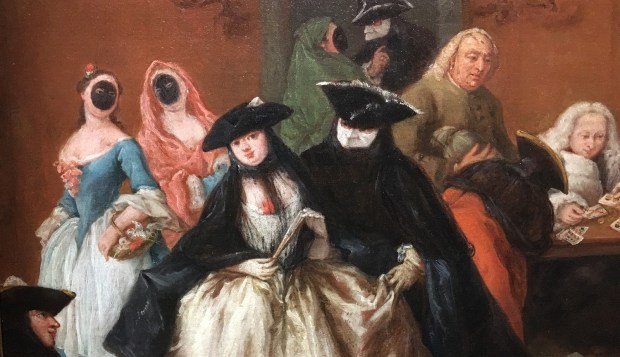
Longhi: The Ridotto

(Musée Cognacq-Jay, Paris, 25 February-25 June 2017)

The Venetians went down dancing. As their commercial and military power ebbed away in the 18th century, they became famous for something else: their carnival. Visitors were drawn by the lure of the masquerade: by the temptation of anonymity, liberty and decadence. But Venice didn’t just come alive at that period between Christmas and the onset of sober, joy-killing Lent. On the contrary, there were festivals all year round: regattas to welcome distinguished visitors; state ceremonies staged like fabulous plays; and the theatre itself, finding its most sumptuous form in Venetian operas. This small-scale exhibition in an equally bijou museum focuses in on Venice en fête, a phrase for which there is, perhaps tellingly, no English equivalent. With the Royal Collection‘s Canaletto show looming on the horizon, like the Bucintoro hoving into view, I thought this would be an excellent way to whet my appetite.

Continue reading