The Corner That Held Them (1948): Sylvia Townsend Warner

★★★

There are great pools of ignorance in my knowledge of literature, and one of these pools is in the region of early 20th century novels by female authors – which is why I so much enjoy the Stuck In A Book blog, because it introduces me to books and writers I simply haven’t come across before. It was there that I first heard about Sylvia Townsend Warner, not in the context of her novels but because Simon was reading a memoir about her. When I stumbled across The Corner That Held Them in my local library, I recognised her name and thought I’d give it a go.

Continue reading

Baudolino (2000): Umberto Eco

★★★½

This was a reread, but it might as well have been a first encounter: I’d read Baudolino back in spring 2004 and remembered virtually nothing of the plot, beyond my delight that Niketas Choniates was one of the main characters. Yes, I probably do need to explain that. By sheer chance, I’d begun to read this novel after a term spent studying medieval European history, during which one of my essays had required me to spend a week getting my head around the mechanics of the Byzantine court. I didn’t really manage it, but it sparked off my fascination with Byzantium and, even better, it introduced me to Niketas. His Annals include what has become one of my favourite historian quotes: ‘There can be no one so mad as to believe there is anything more pleasurable than history.’ Bravo that man.

Continue reading

A Song for Arbonne (1992): Guy Gavriel Kay

★★★★

This is the sixth book I’ve read by Guy Gavriel Kay and it is once again set in his distinctive parallel world with its single sun and twin moons – white and blue – though the names of the countries and the gods aren’t the same as in his other books.  Like the vast majority of his novels, A Song for Arbonne takes place in a context closely mirroring a historical period from our own world: in this case, Southern France in the age of the troubadours.

Continue reading

Treasures of Heaven (2011)

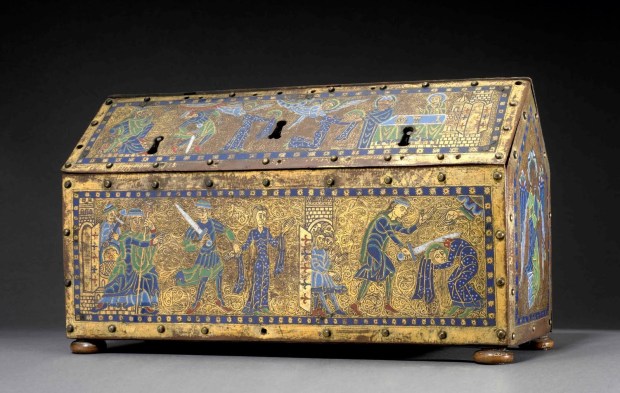
Limoges Reliquary of St Valerie

Saints, relics and devotion in medieval Europe

(British Museum, London (23 June – 9 October 2011)

I have a feeling that, while this exhibition was being prepared, I read an article about concerns expressed by some of the lenders – monasteries, abbeys, great Catholic churches – about whether their precious relics would be treated with the respect they deserved in Protestant England.  If I am right, then it shows that awareness of the Reformation remains strong even today.  However, they needn’t have worried.  The exhibition setting is a triumph of simplicity and the objects are left to work their extraordinary power.

Continue reading