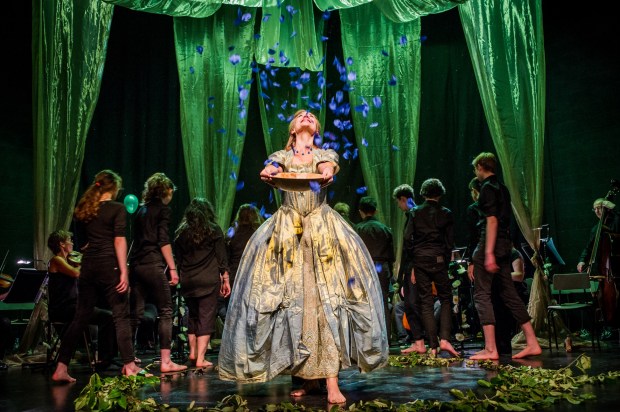
Deathless (2011): Catherynne M. Valente

★★★★

Impatiently waiting for the third novel in Katherine Arden’s Bear and the Nightingale series? This is just the thing to tide you over until it’s published, but Catherynne M. Valente’s novel is no mere stopgap. Indeed, it’s more of an experience than a book, bulging at the seams of its 350 pages. Valente reworks Russian folklore into a dark, dense and compelling narrative which skips in and out of tragic reality. Unlike Arden’s books, it’s also firmly adult, encompassing war, death and desire, while its folklore is the unbowdlerised kind, drenched in sex and blood. The curtain rises at the dawn of the 20th century, in St Petersburg, as the old order collapses, the boundaries between worlds grow thin, and a young girl receives an unexpected suitor.

Continue reading

See What I Have Done (2017): Sarah Schmidt

★★★

On 4 August 1892, a horrifying murder takes place in the little town of Fall River, Massachusetts. Andrew Borden and his second wife Abby are found hacked to death at home. Andrew’s eldest daughter Emma is away, staying with a friend; his younger daughter Lizzie, who finds his body, is unbalanced with shock. No one seems to have heard anything. As the blood seeps into the floors and fabrics of the Borden household, the questions begin; but there is more simmering beneath the surface of this strange family than anyone can hope to comprehend. In this unsettling, claustrophobic novel, Sarah Schmidt evokes the miasma of jealousy, resentment, loneliness and mental instability that result in the shocking events of that August afternoon.

Continue reading

In the Shadow of the Ark (2001): Anne Provoost

★★★

When I saw this novel tucked away in a local charity shop, I pounced immediately. How could I resist a story about the Ark so soon after ferreting deep into the history of its legend? Originally published in Dutch in 2001 (the author is Flemish), it has been translated into English by John Nieuwenhuizen and takes us into a strange and foreign world of fishermen and nomads, boat-builders and prophets. And, at the heart of the tale, is the rumour of a great boat being built in the middle of a desert by a crazy old man, and the young woman who travels with her family to answer the call for workers.

Continue reading

Amadigi di Gaula (1715): George Frideric Handel

Dossi: Melissa

★★★★

(Opera Settecento at St George’s Hanover Square, 24 March 2018)

Opera Settecento’s contribution to this year’s London Handel Festival was a concert performance of this early work based on the bestselling 16th-century chivalric romance Amadis of Gaul. Despite his name, this parfait knight was in fact half-English (the illegitimate fruit of a union between the King of Gaul and an English princess) and was brought up in Scotland. He kept up tradition by conceiving a great amour for Oriana, heiress to the English throne (charmingly described in the libretto as ‘daughter of the King of the Fortunate Islands’). And it’s this element of the story, rather than the knightly escapades, monsters and other adventures, that Handel is concerned with here. In fact, the whole thing takes place within the bounds of an enchanted palace and its gardens. That was the excuse for some truly staggering stage effects in the original production and, although we didn’t have those at St George’s the other night, we did still get to enjoy the beautiful music; not to mention some excellent performances.

Continue reading

The Ark Before Noah (2013): Irving Finkel

★★★★

Decoding the Story of the Flood

Deep within the British Museum is the Arched Room, a soaring vaulted hall lined with shelves of cubbyholes. This is where the cuneiform tablets are kept and it feels rather like the Holy of Holies. I’ve only been once, but that single visit impressed me mightily: not just the architecture, but the hushed air of industry as scholars and students sat hunched over at the central line of desks, working away at deciphering these ancient fragments. Tablets might be business letters, court records or poetry. It’s an ongoing detective story and my brilliant Assyriologist colleagues never know what they’re going to turn up. In this book, the irrepressible Irving Finkel tells the story of the most exciting recent discovery, when a member of the public brought in a cuneiform tablet which offered fascinating new evidence about the story of the Ark and the Great Flood.

Continue reading

The Black Lake (1948): Hella Haasse

★★★½

Originally published in Haasse’s native Dutch as Oeroeg in 1948, this novel has classic status in the Netherlands but seems to be comparatively unknown among English-speaking readers. Without knowing any of that, I bought it three years ago in a translation by Ina Rilke and have only just got round to reading it, discovering a short but poignant novel that explores the consequences of Dutch colonialism in what is now Indonesia. Haasse herself was born in Batavia (now Jakarta) and so her tale has a ring of authenticity about it, as it follows the friendship of two boys: one the son of a wealthy Dutch plantation owner in Java; the other, the son of the estate’s Indonesian manager.

Continue reading

The Unbinding of Mary Reade (2018): Miriam McNamara

★★★

Well, hoist the mainsail, stock up on rum and run up the Jolly Roger: it’s time for a swashbuckling tale of piratical adventure! And, this time, the boys don’t have all the fun. Miriam McNamara introduces us to Mary Reade, who runs away to sea in 1717 disguised as a man, and who finds a new lease of life when the Dutch ship on which she serves is taken by pirates. Mary is impressed by the elegant pirate captain, ‘Calico’ Jack Rackham, but even more taken with the red-headed woman who fights in a red velvet gown at his side. This is Anne Bonny who, along with Mary, is one of the very few known female pirates. McNamara’s story plays a little fast and loose with the ‘facts’, though there are few enough of those, but she conjures up an engaging read with a very modern take on gender identity, which does justice to the spirit of Mary’s extraordinary story.

Continue reading

Pistols for Two (1960): Georgette Heyer

★★★

When I was sent a review copy of the newly-issued Snowdrift, a collection of Regency short stories by Georgette Heyer, I realised that this volume was a reissue of Pistols for Two, which I already owned (albeit with three newly-added stories). I’ve therefore decided to deal with Snowdrift in two parts: first, by discussing the main batch of stories under their original title Pistols for Two and then, in a separate post, discussing the three new stories included in Snowdrift. Hopefully that won’t be too confusing and it’s also given me a chance to retrieve this rather simpering 1976 edition from my bookshelf. Of course, you know what to expect from these stories: it’s Heyer at her cosiest, by turns predictable and implausible, but always full of wit and humour.

Continue reading

Acis and Galatea (1718): George Frideric Handel

Handel: Acis and Galatea

★★★★

(London Handel Orchestra at St John’s Smith Square, 19 March 2018)

This year’s London Handel Festival kicked off with this pastoral drama from 1718 which, described in the programme as ‘Handel’s most perfect work’, had a lot to live up to. It was commissioned by the Earl of Carnarvon, who was also the patron of Handel’s Chandos Anthems and his Esther, and its genesis as a pastoral masque is reflected in its brevity – a mere ninety minutes – and its plot stuffed with nymphs, shepherdess and happy rustics. I’m slightly allergic to pastoral operas, which I can’t take seriously, but I have to admit that the music in Acis and Galatea is beautiful – no matter how many times the English libretto made me wince. Charmingly staged in St John’s Smith Square, and performed by a strong young cast, this was a very Baroque evening out.

Continue reading

The Standing Chandelier (2017): Lionel Shriver

★★★★

This is the first book I’ve read by Lionel Shriver (except, of course, for We Need To Talk About Kevin) and so I came to it without many preconceptions. More novella than novel, it impressed me a great deal with its incisive and unsentimental view of human nature. We may not like the picture that Shriver reflects back at us, but her characters all feel so very convincing. It’s a story that many of us can easily imagine, even if we don’t have direct experience of it, because it starts with a friendship: an old friendship, of twenty years’ standing, between a woman, Jillian Frisk, and a man, Weston Babansky, and how their easy dynamic is challenged by the arrival of Weston’s girlfriend Paige.

Continue reading