The Boy with the Porcelain Blade (2014): Den Patrick

★★★

The Erebus Sequence: Book I

I can’t remember exactly where I first came across The Boy with the Porcelain Blade, but I was intrigued enough to buy it without knowing anything about it. Then, shortly before I was due to start it, I spotted a review at the Speculative Scotsman, which made it quite clear that the book was going to have some weaknesses. (I don’t usually read reviews of things that I’m about to read for myself, but I’d only just discovered his blog and was enjoying it too much to stop.) However I went ahead and read it anyway. The title was interesting, the cover enticing and, as we all know, I’m not the kind of girl who can easily resist a fantasy swashbuckler.

Continue reading

Veronese: Magnificence in Renaissance Venice (2014)

Veronese: Conversion of the Magdalen

(National Gallery, London, until 15 June 2014)

The National Gallery’s Veronese exhibition is already being described as the one show that you have to see this year and glowing opinions have proliferated: from The Times’s five-star review to the enthusiastic post by the exacting Grumpy Art Historian. Needless to say, I’d been very much looking forward to it. And I was especially excited because, a couple of weeks ago, I went to a very enjoyable lecture by Matthias Wivel, one of the curators, who’d suggested a way of ‘reading’ Veronese’s pictures that I was keen to put to the test.

Continue reading

The Eyre Affair (2001): Jasper Fforde

★★★★

Thursday Next: Book I

For several years my friend Martin has been telling me that I had to read this book. I don’t know why I resisted for so long: stubbornness, probably, more than anything else. But recently another friend, Alex, completely independently recommended the same thing. And so, finding myself once again in an airport lounge with nothing to do, I decided it was time to give Thursday Next a go. My reaction began with wariness, progressed into bafflement and eventually shuffled rather awkwardly into acknowledgement that this was rather good.

Continue reading

The Gospel of Loki (2014): Joanne M. Harris

★★★½

I’ve only ever read one book by Joanne Harris and that (predictably) was Chocolat, many moons ago. As a result, I was intrigued when huge posters appeared all over the Underground advertising her most recent novel, her first foray into what the publicists call ‘fantasy’ but which is actually revisionist mythology. Naturally there was no way I could resist it. I’ve always loved clever, creative, not-entirely-trustworthy heroes and it’s a given that the devil always gets the best lines. Moreover, with the Vikings exhibition looming at the British Museum it seemed the perfect moment to brush up on my Norse mythology. And, although Harris would (apparently) prefer us not to mention it / him and simply to judge the book against the myths themselves, there’s always that pop-culture elephant lurking in the corner of the room. Loki is very much the man of the moment.

Continue reading

The Bull from the Sea (1962): Mary Renault

½

Published four years after The King Must Die, this book picks up the thread of Theseus’ story once again. Having brought down the ancient Cretan house of Minos, he comes home to Athens flushed with glory, accompanied by his loyal team of bull-leapers, the Cranes. But the joy fades quickly: Theseus is greeted by news of his father’s premature death; and, for all the Cranes, the Athens they return to seems smaller and more provincial than the city they left.

Continue reading

Strange Beauty: Masters of the German Renaissance (2014)

Cranach: Cupid complaining to Venus

(National Gallery, London, until 11 May 2014)

If forewarned is forearmed, then I went to this exhibition fully armed with the mixed (and sometimes frankly baffled) reactions of friends and colleagues. The National Gallery are clearly trying to do something slightly different in this show, and the ambition itself is commendable, but they just don’t quite pull it off. The key distinction I’m going to have to make in this post is between the works on show, which were indeed beautiful, and the concept of the exhibition itself, which seems to skip confusingly between several different driving themes.

Continue reading

Winter Pilgrims (2014): Toby Clements

★★★★

Kingmaker: Book I

Toby Clements’s novel opens in the bitter cold of the winter of 1460, in the midst of the Wars of the Roses, in a country teetering on the brink of anarchy. In the wake of the battles of St Albans and Ludford Bridge, the weak and unstable King Henry VI and his wife, the virago Margaret of Anjou, cling to the last threads of their power, while the armies of the Duke of York and the Earl of Warwick winter for safety in Calais and plot their next move.

Continue reading

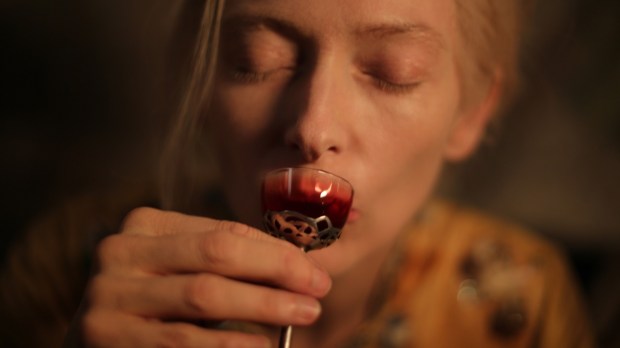
Only Lovers Left Alive (2013)

Only Lovers Left Alive

★★★★

(directed by Jim Jarmusch, 2013)

I was annoyed to miss this at the London Film Festival last autumn, but fortunately it’s been given a limited cinema release and so off we trotted to the Odeon in Covent Garden. I hadn’t read any reviews, but decided it was worth seeing if only for the cast. I’d suspected it would be arty and beautiful and perhaps slightly pretentious, but I hadn’t expected it to be so self-aware; nor was I expecting it to be so funny. With an adolescence full of Anne Rice novels under my belt, I found myself faced with a film that was both a love-letter to, and a subtle parody of the kind of world-weary vampirism that touched my teenage heart.

Continue reading

The Invisible Woman (2013)

The Invisible Woman

★★★★

(directed by Ralph Fiennes, 2014)

My goodness, it’s been a while! Work has been keeping me busy and it’s been hard to find the time to devote to blog posts. However, I simply have to write a few words about this film, which I actually saw a couple of weeks ago, before I forget the finer details. The Invisible Woman tells the story of Charles Dickens’s well-known love affair with the young actress Ellen (Nelly) Ternan. Based on Claire Tomalin’s book, the film looks at the development of the relationship through Nelly’s eyes, giving the romance even more interesting layers and ethical grey areas than it might otherwise have had. It manages to be thoughtful, intelligent and refreshingly different from your average Victorian bonnets-and-bustles drama, while still revelling in period colour and costume.

Continue reading

Coriolanus (1605/8): William Shakespeare

Coriolanus: Donmar Warehouse

★★★★

(Donmar Warehouse, 2013, directed by Josie Rourke)

During the Donmar Warehouse’s run of Coriolanus, tickets were so scarce that people camped outside in sleeping bags in the hope of getting a day ticket for the show. Interviewing the director Josie Rourke, just before a live broadcast of the play, Emma Freud asked what could account for this surge of popular interest. Somewhat disingenuously, Rourke enthused about the modern parallels to be found in this story. It’s a tale about the power of public opinion, in which a great soldier is brought down by his failure to transition to the hand-pressing, baby-kissing world of popular politics. She suggested that the play spoke to modern sensibilities. It’s about an era of austerity, about class divisions between the people and those who rule them, and about the fact that the people notionally have a voice but realistically don’t feel they have any power to change their government.

Continue reading