Sword at Sunset (1963): Rosemary Sutcliff

★★★★½

More than half a century after the last legions marched out of Britain, a man lies dying in a monastery, with apple trees stirring in the wind beyond his window. His name is Artos, and he has been many things: bastard-born nephew and adopted son of the old High King, Ambrosius; the Count of Britain; the leader of the Companions, a band of heavy cavalrymen sworn to his banner, who have devoted their lives to defending what remains of civilisation against the growing dark of the Saxon invasions.

Continue reading

Pompeii (2014)

Pompeii (the film)

(directed by Paul W.S. Anderson, 2014)

And now for something completely different. I do like taking a break now and then to indulge myself with a spot of cheerful ranting. I wasn’t even sure whether to write a post on Pompeii or not. I don’t like being overly critical and that’s doubly the case when a film doesn’t even have the courage to be as wildly barking mad as Anonymous was; but is simply duff. In the end, however, I decided it was my duty to prevent anyone else wasting one-and-three-quarter hours of their life on this. (That’s the equivalent of half a Baroque opera, two episodes of Game of Thrones or almost four episodes of Blackadder. Judge wisely.)

Continue reading

Bernini’s Beloved (2012): Sarah McPhee

★★★★½

 A Portrait of Costanza Piccolomini

Now here is a love story with a sting in the tail for Valentine’s Day. Written with novelistic verve by Sarah McPhee, a professor at Emory University, it is an example of how art history can be brought to scintillating, pulsing life when done well. McPhee’s point of departure is a striking marble bust of a woman, carved by Bernini in 1637 and traditionally believed to record the features of a woman named Costanza with whom he was passionately in love. Her husband was one of Bernini’s assistants.

Continue reading

The Soldier of Raetia (2009): Heather Domin

★★★½

Valerian’s Legion: Book I

This was an automatic recommendation from Goodreads, which clearly leapt to certain conclusions about my reading preferences based on the large number of books I own by Mary Renault. However, as has happened before, their suggestion hit the mark. Domin writes beautifully, creating rich and believable characters, and succeeds in giving the flavour of an historical period without overloading the exposition and research. I’d never have stumbled across her book by myself and, even if I had, I might’ve (unfairly) been a little cautious because, when I read it, it had only been published digitally. In that case, I would have missed a rather lovely novel. It was a very pleasant surprise; and I’m pleased to hear there’s a sequel in the works about the same characters.

Continue reading

Eromenos (2011): Melanie McDonald

★★★

A novel of Antinous and Hadrian

I’m really having difficulty figuring out what I think of this book. It raises so many interesting questions in light of my recent reread of Yourcenar’s Memoirs of Hadrian. For one, it gives Antinous a voice of his own, which is fitting considering that his fictional existence, like his memory, has been dominated by Hadrian’s idealised gaze. On the other hand the tone of the writing is uneven and in many places it’s weighed down by a desire to show how much research has gone into this depiction of the Roman world. It is a striking, unsettling, flawed book but the way that it acknowledges and fences with Yourcenar’s all-conquering vision of these historical figures is quite fascinating.

Continue reading

Memoirs of Hadrian (1951): Marguerite Yourcenar

★★★★★

Like a traveler sailing the Archipelago who sees the luminous mists lift toward evening, and little by little makes out the shore, I begin to discern the profile of my death.

With these words we are drawn into one of the great modern examples of historical fiction: a book which was first published in 1951 but which had been taking shape in the author’s mind for thirty years before that. It was a reread for me – a treat before Christmas – and in my opinion it ranks with Renault and Dunnett as an example of how magnificently a writer can immerse you in the conviction of a vanished age.

Continue reading

Life and Death in Pompeii and Herculaneum (2013)

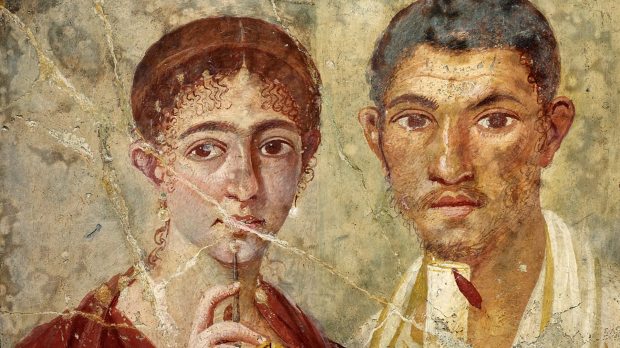
Roman fresco of a couple: Terentius Neo and his wife

(British Museum, London, until 29 September 2013)

If last year’s blockbuster exhibition was Leonardo at the National Gallery, this year’s is Pompeii at the British Museum. Both names have the kind of pulling-power that make it virtually impossible to get tickets, although I’m happy to say that there is still availability for some of the less appealing slots (we visited at 9am on a Sunday morning). Besides, 300 tickets are released by the British Museum every day, so you can always queue before opening time in the hope of getting one. Do try to see it. You won’t be disappointed.

Continue reading

Pompeii (2003): Robert Harris

★★★½

Attilius is an aquarius: a specialist engineer who constructs and maintains the great aqueducts that feed the Roman Empire. His first significant posting is to Misenum, the great naval base at the tip of the Bay of Naples and the terminus of the immense aqueduct, the Aqua Augusta, which waters the resorts and towns around the bay. Attilius’ predecessor, the aquarius Exomnius, has vanished in mysterious circumstances; but nobody admits to knowing where he’s gone. And anyway Attilius has more pressing matters on his hands: his gang of recalcitrant workmen don’t take him seriously; his foreman Corax does all he can to undermine his authority; and the waters of the Aqua Augusta have begun to fail.

Continue reading