How To Stop Time (2017): Matt Haig

★★

So that’s the end of the Summer Without Men 2018. I’ve thoroughly enjoyed myself: I’ve read 27 books over the two months of the challenge, which is pretty respectable; even if I didn’t quite manage to embrace the broad spectrum of subjects that I’d hoped. But those other books are still there, waiting, and will be read in due course. Having a reason to focus on the female authors in my library made me appreciate their scope and range and wit so much more, and I think I might make this an annual thing. There’s no danger of running out of books: at my present count, I have 755 books by women on my to-read list (across all genres, both digital and hard-copy – yes, that figure rather scared me as well), so I could actually do Three Years Without Men and still have books to spare. But I can’t deny I’m looking forward to letting the men in again – as long as they behave themselves. I’ve had books by Ben Kane and Peter Ackroyd and Robert Harris and all sorts of people just sitting there, tempting me for the last two months, so we might have a bit of a rush on Romans and Vikings and general muscly-warlike-stuff until the novelty wears off again. But we’re easing ourselves in gently for the first book, with a typically sentimental, introspective novel by Matt Haig.

Continue reading

The Western Wind (2018): Samantha Harvey

★★★

It’s the beginning of Lent in the isolated Somerset village of Oakham, some time in the late fifteenth century. As the villagers prepare for their forty days of penance, a dead man is seen in the river. By the time rescuers come to help, the body has been swept away, but a fragment of clothing confirms its identity: Tom Newman, a prosperous, curious dreamer, and one of the few villagers to have ventured beyond the parish boundaries. The rains have been falling heavily and the riverbanks are thick with mud. He could have slipped in. But the question remains: was it misadventure or murder? As the small community huddles under bleak skies and heavy rains, the priest John Reve struggles to comprehend the mystery, dogged by the interference of the visiting dean, weighed down by the confessions of his parishioners, and troubled by the way that Newman’s death threatens to pull apart a whole network of secrets, doubts and obligations that bolster Oakham against the outside world.

Continue reading

The Last Children of Tokyo (2014): Yoko Tawada

★★½

I keep reading modern Japanese fiction in the hope that, one day, it will suddenly all make sense; but it hasn’t happened yet. This slim little book is, for the most part, a gentle and achingly tragic tale of a near future that feels all too plausible. Environmental and nuclear catastrophe has led to political isolationism, mass extinction and the reversal of the natural order: the old remain spry and sprightly into extreme old age, while the children suffer from genetic mutations and endemic sickness. We watch an old man struggling to care for his great-grandson, and trying to come to terms with the guilt of an entire generation. It all flows along terribly well until the last pages, when a sudden and utterly unnecessary narrative shift leaves you floundering at the final curtain.

Continue reading

Gentlemen & Players (2005): Joanne Harris

★★★★

It’s funny really: I’ve spent most of my life with completely the wrong impression of Joanne Harris, writing her off as an author of cutesy French tales like Chocolat (which perhaps isn’t particularly cutesy itself; I must reread it). And yet she’s so much more than that. She’s written ironic mythical fantasy (The Gospel of Loki), nuanced historical fiction (Holy Fools) and now, I discover, gripping thrillers. I came to Gentlemen & Players because I have a soft spot for fiction set in schools (blame The History Boys, I suppose), and I was attracted by this book’s setting at St Oswald’s: a self-consciously old-fashioned private school for boys. But I stayed for the increasingly compelling tale of Machiavellian revenge, as the school unwittingly nurtures a viper in its bosom: someone with an old grudge against St Oswald’s, who has finally decided to take down the school bit by bit from within. And, when I finished the book, I was sorely tempted to go right back to the beginning and start again, because Harris pulls off a piece of narrative legerdemain that is so completely brilliant that I wanted to revisit everything with full understanding.

Continue reading

Tamburlaine (1587): Christopher Marlowe

tamburlaine_production_photographs__2018_2018_photo_by_ellie_kurttz__c__rsc_258815-1.tmb-img-1824 (2)

★★★★

(Royal Shakespeare Company at the Swan Theatre, Stratford-upon-Avon, 25 August 2018)

Something is brewing in the Scythian steppes. As the power of once-mighty Persia begins to wane under the rule of foolish Mycetes, rumours reach the court of a new leader rising in the north: a former shepherd, who has gathered a band of thugs and thieves and believes he is destined to rule the world. His name is Tamburlaine. Christopher Marlowe’s play is rarely performed, which is a pity because it has powerful resonance in the modern world. The RSC’s production, directed by Michael Boyd and designed by Tom Piper, was first staged in New York in 2014 and boils down Parts 1 and 2 into a single three-and-a-half-hour behemoth of death and ambition. (Imagine seven seasons of Game of Thrones condensed into 180 minutes and you have some idea of the amount of blood involved.) These cuts emphasise Tamburlaine’s dizzying rise to power, and the whole play is anchored by a magnificently charismatic performance by Jude Owusu.

Continue reading

The Merchant of Venice (1598): William Shakespeare

Shakespeare: Merchant of Venice

★★★★

(Illyria Theatre at Arundel Castle, 18 August 2018)

Riotous isn’t usually a word that I associate with The Merchant of Venice, but it’s really the only word that does justice to Illyria’s madcap outdoor production currently touring around the UK. Performed by a band of only five actors, who don a breathless variety of roles by running round the back of the stage and reappearing with a new coat or hat (leaving us in tears of laughter while doing so), it was perfect summer Shakespeare. Plus, before I get going, here’s a funny story: we’d also meant to see an outdoor Merchant at Westminster Abbey earlier this month, but as the day moved into evening and the sullen rain strengthened, we decided to chicken out. Imagine our amusement when we arrived at Arundel Castle for our Illyria expedition, and realised that the Westminster show had been Illyria too! We could well have ended up seeing the same show twice. Not that this would have been any great hardship, I hasten to add.

Continue reading

An Almond for a Parrot (2016): Wray Delaney

★★★

Some weeks ago, I wrote that I was weary of Victorian jail-fiction, so you may think it strange that here I am, posting on another novel about a woman in prison. But this is different to the likes of The Corset: there are no naive lady visitors, no stern matrons, nor are we in the prim 19th century. No: it’s 1756, in the very bosom of the Georgian age, and this is a racy fable full of rogues and ladies of the night, and touched with odd, piquant flashes of magic. Tully Truegood is in Newgate, awaiting trial for murder, her life briefly secured by the child growing under her heart. She has been many things – a daughter, a whore, a sprite, and a magician – and, as she waits, she feels a compulsion rising in her to tell her story to the one man, now long absent, that she’s ever loved.

Continue reading

Much Ado About Nothing (1598/99): William Shakespeare

Shakespeare: Much Ado About Nothing

★★★★

(Antic Disposition at Gray’s Inn Hall, 21 August 2018)

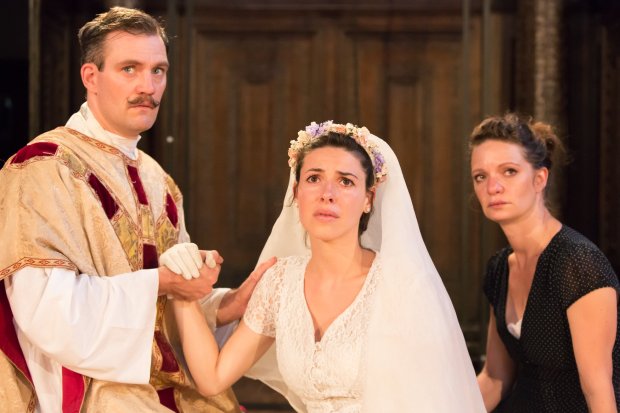
There will be a number of theatrical posts over the next few days, for two reasons: first, I have seen an awful lot of plays recently and, secondly, I still have to catch up with some plays I saw earlier in the summer. Fortunately, they’re all terribly good. This is one post, however, that’s pretty quick off the mark: it was only this week that I went to Gray’s Inn Hall to see the ever-brilliant Antic Disposition and their current production of Much Ado About Nothing. The company always performs their plays in France over the summer before coming to London and that’s had two important influences on their reading of Shakespeare’s delicious romantic comedy. They’ve adopted a mixed French and English cast for Much Ado, with some familiar faces from the blended cast of their magnificent Henry Vand Messina moves from Sicily to become a small French village, just after the end of the Second World War. The stage is set for love, longing and a merry entente cordiale, as romance blossoms over a lazy postwar summer.

Continue reading

Giulio Cesare (1724): George Frideric Handel

Handel: Giulio Cesare

(directed by David McVicar, Glyndebourne, 20 July 2018)

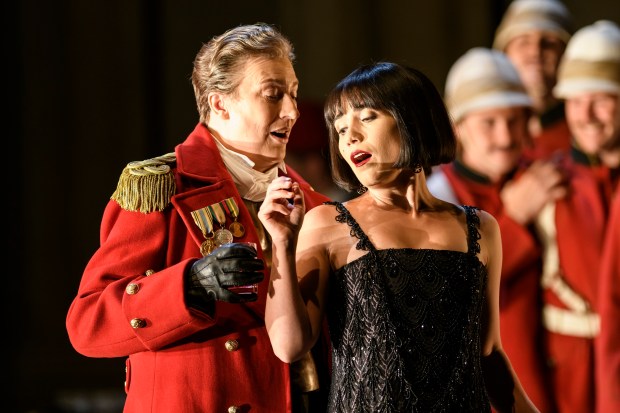
It’s always nerve-racking when you go to see something you love live for the first time. What if it doesn’t live up to expectations? What if one of the cast has a sore throat? What if, horror of horrors, the manager comes onstage to announce a substitution? But at the same time, how can you resist? My opera buddy H and I had decided that we would pay virtually anything to see the revival of David McVicar’s marvellous Giulio Cesare at Glyndebourne, and our resolution was put to the test when the more affordable seats were snapped up within seconds after going on sale. However, our budget-stretching seats in row B were absolutely worth the cost. Many of the cast from the 2005 production returned, with Sarah Connolly triumphant in the title role, and we could admire every little detail. Coupled with a lavish picnic and a gang of equally excited friends (inevitably christened Team Giulio), it made for a perfect day out, and I can promise you that it did live up to all those months of anticipation.

Continue reading

The Thirteenth Tale (2006): Diane Setterfield

★★★★

When I reviewed Bellman & Black, some years ago, several of you urged me to go back and read Diane Setterfield’s earlier novel The Thirteenth Tale. And so I have! You see, I do listen. It just takes me five years… And it was worth the wait, for I thoroughly enjoyed it. Setterfield weaves a modern Gothic tale full of mystery and tragedy, spiced with congenital madness, the crumbling rooms of a remote old house, and twins. Better still, it has a genuine bibliophile as the heroine and a reclusive writer as its enigmatic object. In fact, the whole story is a love letter to the power of fiction, which can sweep us away from the world around us, provide a retreat in hard times, and even transform our own pasts.

Continue reading