City of God (1979): Cecelia Holland

★★

A Novel of the Borgias

I’m on a bit of a Borgia kick at the moment. Having just finished Sarah Dunant’s new book In the Name of the Family (the post will go live on the 18th, nearer its publication date), I moved on to Cecelia Holland’s vision of 16th-century Rome. The Borgias are at the apex of their power, with Alexander VI on the Papal throne, his daughter Lucrezia being offered in marriage to the d’Este in Ferrara, and his son Cesare driving the fear of God into the Romagna at the point of a sword. As Italy shifts under the weight of their dominance, a sharp-eyed envoy at the Florentine embassy begins to wonder whether he can use the Borgias as a stepping stone to his own fortune. As a roistering story of the Roman underbelly, full of dark alleyways, abductions and subterfuge, this should have been an absolute stunner… and yet it’s oddly stilted and unsatisfying.
Continue reading

Defacing the Past (2017)

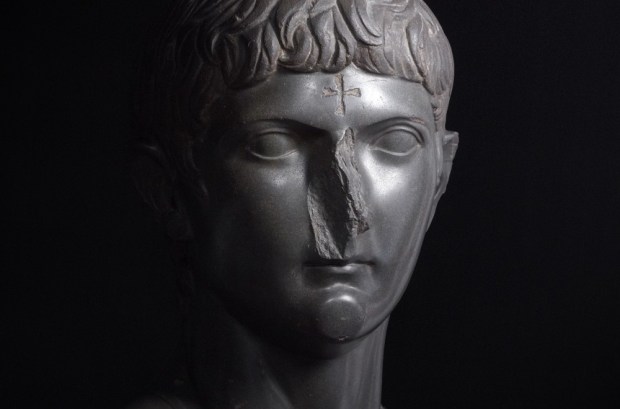
Head of Germanicus

Damnation and Desecration in Imperial Rome

(British Museum, London, until 7 May 2017, Room 69a)

We all know what it means to deface something, but pause a moment and think about the word in greater detail: to de-face, to erase identity, to obliterate the memory of a person. It is one of the most profound punishments that history can inflict, for it either condemns a man to oblivion or associates him eternally with the shame of his downfall. This small but carefully curated show, focusing on coins and medals with some pieces of sculpture, looks at how defacement was used as a political punishment in Ancient Rome, and how it grew out of preexisting traditions of damnatio memoriae that have continued in various forms right up to the present day.

Continue reading

Four Princes (2017): John Julius Norwich

★★★★

Henry VIII, Francis I, Charles V, Suleiman the Magnificent and the Obsessions that Forged Modern Europe

Over the years I’ve assembled a variety of John Julius Norwich’s history books, because he conveniently writes on precisely the topics that fascinate me: Byzantium; Sicily; the Normans in Italy; and so forth. However, although I’ve dipped into all of these books, I’ve rather shamefully never finished any of them, having been distracted for various reasons from savouring Norwich’s sublimely elegant prose. This new history, shorter than the others and full of a delightful liveliness, has the honour of being the first Norwich that I’ve read cover to cover. Taking the unusual format of a group biography, it focuses on the dazzling first half of the 16th century, when four men between them bestrode Europe like colossi. It’s an extremely accessible introduction to the period and the men in question.

Continue reading

Blood Upon the Sand (2017): Bradley Beaulieu

★★★½

The Song of the Shattered Sands: Book II

With barely a pause for breath, I headed on to the next book in Bradley Beaulieu’s towering desert fantasy. Like its predecessor, it’s packed with adventure as our protagonist Çeda works her way deeper into the community of Blade Maidens on the royal mount of Tauriyat, while her childhood friend Emre knits himself closer to the rebel army of the Moonless Host. I don’t know how many books Beaulieu intends to write in this series, but this volume has the feel of a typical ‘middle’ book: threads are taken up from the first book, the scope widens, and an increasingly complex weave of intrigue and skulduggery leaves us with several unanswered questions at the end. Yet it remains compellingly rich and detailed: the wealth of Beaulieu’s imagination is never in doubt.

Continue reading

Esther: Royal Beauty (2014): Angela Hunt

★★★

A Dangerous Beauty Novel: Book I

Ladies and gents, it’s time for another foray into Achaemenid historical fiction. This time we’ll be travelling via the medium of Biblical fiction – a genre which is not of any great interest to me, in and of itself, but which accounts for the vast majority of historical fiction set in the ancient Near East. As you’ll probably remember, I read a novel about Esther not very long ago and I was curious to see whether Hunt’s rendition of the story would have anything in common with Lofts’s beyond the bare bones of the story related in the Bible. The answer is: very little, but Hunt has evidently read her Herodotus, which means that this Esther has a weight of historical plausibility that Lofts’s lacked.

Continue reading

My Grandmother Sends Her Regards and Apologises (2013): Fredrik Backman

★★★★

Fredrik Backman has sidled into my awareness during the last couple of months and I now marvel that it took me so long to discover him. Funnily enough, this wasn’t the first of his books that I planned to read – that was his debut novel, A Man Called Ove – but when I spotted it in the library the other day, I thought I’d take the plunge. And it is absolutely brilliant. A big-hearted, generous, poignant novel, this tells the story of almost-eight-year-old Elsa, her rakish Granny, the wonderful world of fairy tales that they share, and the treasure hunt that Granny leaves behind for Elsa when she dies. A story of eccentricities, regrets and second chances, this had me choking back tears at least three times, while simultaneously wanting to give it a massive bear-hug. Utterly magical.

Continue reading

Eric (1990): Terry Pratchett

★★

The Discworld Reread: Book IX

Technically speaking, Eric isn’t part of the Discworld series. Guards! Guards! calls itself the eighth book and Moving Pictures the ninth, but Eric is always listed in between them. It’s more of a novella than a novel and seems to be aimed at more of a young adult audience, as an inept teenage demonology hacker finds his summoning rite answered by the worst possible ‘demon’ in the world: the eternally inept wizard Rincewind.

Continue reading

Twelve Kings in Sharakhai (2015): Bradley Beaulieu

★★★★

The Song of the Shattered Sands: Book I

You hear a lot of fantasy novels being described as ‘epic’, but the opening novel in Bradley Beaulieu’s new series deserves that epithet better than most. It isn’t just huge – 580 pages in the hardback version – but it features a monumental concept, rich with history, legends and backstory, which is all the more memorable for stepping outside the usual traditions of Western European-inspired fantasy. Beaulieu’s Sharakhai is a desert city of mud-brick and stone, a compelling blend of Marrakesh and ancient Baghdad, full of intrigues, secrets and half-truths. For one young woman, seeking vengeance for her mother’s murder, these secrets will offer a road out of the fighting pits, and a future more dazzling and more lethal than anything she could have dreamed.

Continue reading

Midnight Blue (2016): Simone van der Vlugt

★★★

Recently widowed, Catrin Barentsdochter is a free woman again at the age of 25 and vows that 1654 will finally be her year of change. She’s tired of working the land and amusing herself by painting decorative furniture in her spare time. She wants nothing more than to escape the claustrophobic parochialism of her little village, De Rijp, and make a new life for herself in the nearby town of Alkmaar. However, when an unexpected meeting leads to an offer of work in distant Amsterdam, Catrin realises that the scope of her world might be wider than she ever dreamed.

Continue reading

Rome: The Emperor’s Spy (2009): M.C. Scott

★★★★

The Rome Novels: Book I

Manda Scott; the Emperor Nero; chariot-racing; mystery cults; a love triangle; and an imperial spy fighting against time to prevent disaster: it’s a formidably tempting combination. Needless to say, I’ve been itching to read this ever since I finished the last of the Boudica novels and was finally able to wait no longer. And it thoroughly lived up to expectations, as I tore breathlessly through an audacious, fast-paced story, plotted with an almost Dunnettian dexterity.

Continue reading