Post Captain (1972): Patrick O’Brian

★★★★

Aubrey & Maturin: Book II

Heloise has been gently encouraging me to continue with Aubrey & Maturin ever since I posted on Master and Commander and I have finally kept my promise that I would do so. To be honest, in the aftermath of The Mammoth Hunters this proved to be the perfect book: full of adventure and incident, populated by wonderfully endearing but flawed characters, and written like a dream. I’m swiftly coming to realise that O’Brian is one of those authors whose books you can turn to with a happy sigh, like easing into a warm bath, because you know that as a reader you don’t have to do any work at all: just sit back and enjoy.

Continue reading

French Portrait Drawings from Clouet to Courbet (2016-17)

Courbet: Self Portrait

(British Museum, 8 September 2016-29 January 2017)

I’ve been debating whether to write about this exhibition here. In the act of doing so, I’m banishing mystique and bringing the blog and the real world together for the first time; but my desire to write about this show was too strong to resist. It’s my exhibition, you see. I’ve been working on it ever since I joined the British Museum in late 2014 and now, to my mingled delight and terror, it’s on the brink of opening to the public.

Continue reading

Lament for the Fallen (2016): Gavin Chait

★★★★

Again, it was the cover that did it. The eerie face, with its scored lines and sunburst of golden rays, reminded me of an ancient tribal mask. I was intrigued by the apparent disconnect between that and the sci-fi plot summarised on the back of the book. Gavin Chait’s first novel turned out to be quite different from any such novel I’ve read before, and not just for its African setting. While on the one hand it offers a sobering future, in which the planet’s ecology has been ravaged by greed, it also shows seedlings of hope, as people strive, even in the darkest days, to create a better world.

Continue reading

The Mammoth Hunters (1985): Jean M. Auel

★★½

Earth’s Children: Book III

As we embark on the third book in Ayla’s story, we pick up the narrative thread exactly where we left it. At the end of The Valley of Horses we left Ayla and Jondalar at the moment in which they are hailed by a hunting party; here we see the group approach and make their introductions. They are Mamutoi – Mammoth Hunters – and invite the young couple to visit their settlement, the Lion Camp. As she follows them, Ayla is torn between curiosity and fear, as these are the first Others she has seen except for Jondalar; but her anxiety will prove to have no foundation. She will find not only new friends among the Mamutoi but also a persistent and attractive new admirer.

Continue reading

The Secret Chord (2015): Geraldine Brooks

★★★½

The men of Yudah still tell stories of how their ancestors followed the prophet Moshe out of captivity in Mitzrayim to found new cities of their own. But their recent history has been less glorious. Troubled by Plishtim raiders from the Levantine coast, the people come to the prophet Shmuel begging him to anoint a king which, unwillingly, he does. The choice falls on Shauel, tall, handsome and charismatic, but Shauel and Shmuel soon diverge in their ambitions.

Continue reading

Georgia O’Keeffe (2016)

O'Keeffe: Oriental Poppies

(Tate Modern, until 30 October 2016)

I had great intentions to see masses of exhibitions during my summer break, but didn’t make it to quite as many as planned. I did, however, head over to Tate Modern (not a place I go often enough), where I explored their new wing, admired the panorama of London from its viewing deck and, most importantly, visited their current exhibition on Georgia O’Keeffe. As I’ve said before, my knowledge of modern artists is sketchy to say the least – I generally deal with artists who’ve been dead for at least a hundred years – and I knew very little about O’Keeffe, but the exhibition did a great job of introducing me to her innovative, colourful and elegant paintings.

Continue reading

The Gracekeepers (2015): Kirsty Logan

★★★

This was a chance find in the library: I was attracted by the dreamily beautiful cover, which reminded me of The Life of Pi, and by the intriguing summary on the back. Its ethereal strangeness was indicative of the book itself, which turned out to be a pared-back fable set in a fantastical post-apocalyptic future. While it was lovely – and offered me another fictional circus to add to my tally – it also felt somehow truncated, as though it was only just getting underway when the pages came to an end.

Continue reading

A Little Life (2015): Hanya Yanagihara

★★★★½

This is going to be hard to write about, and not because I don’t know what to say, but because I don’t know how to say it. I want to use words that I customarily turn to when speaking of things I admire: brilliant, magnificent, splendid, astonishing. But such words neuter the power of this book and render it somehow superficial and glittery, when what I actually want to convey is that this novel one moment twists your stomach and ties knots in your throat, and the next offers you a moment of beauty as perfect and transitory as sunlight reflecting off a lacquered bowl. I’m not sure I can express how good this book is without trivialising it. If I say that, on finishing it, I sat in the shadows and actually wept with rage and the poignant shame of it, that might give you some idea of its impact.

Continue reading

The Last Concubine (2008): Lesley Downer

★★★½

Ever since I went to Japan, I’ve been curious to learn more about its ancient feudal culture. While this may not be the kind of serious historical introduction that I should be reading, it does help to give a certain flavor of the atmosphere and, besides, Lesley Downer is a reliable guide. I read her history book Geisha about six months ago and was impressed then by the engaging way she wrote about these mysterious, endlessly fascinating creatures. As one who has studied and lived in Japan, she’s managed to get a feel for the complexities of the country’s social history, and her knowledge of its customs and traditions pervades every corner of this novel.

Continue reading

Alcina (1735): George Frideric Handel

Alcina: George Frideric Handel

★★★½

(Longborough Festival Opera, Greenwood Theatre, 4 August 2016)

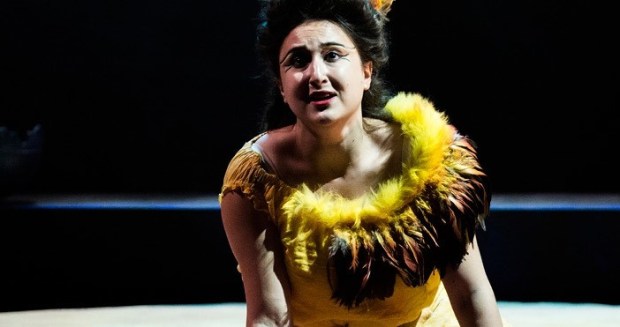
After seeing their impressive Xerxes last year, I was really looking forward to seeing what Longborough Festival Opera would achieve with this year’s Young Artists Production: Alcina. Let’s face it, the one version I’ve seen so far was often striking in the wrong way. And I wasn’t disappointed. Stripping their set back to basics, the company conjured up all the strangeness and danger of Alcina’s enchanted island in a production which, for me, evoked strong parallels with The Tempest. Sung in the original Italian and boasting some fine performances, it was a very welcome counterbalance to the exuberant but somewhat alarming Aix version, restoring ethereal magic to the heart of the story.

Continue reading