In the Name of the King (2011): A.L. Berridge

★★★★½

Chevalier: Book 2

As the world grows stranger, I’ve taken comfort in something so satisfying, so delightful and escapist, that it should almost be prescribed on the NHS. It’s been over two years since I read Honour and the Sword, the first of A.L. Berridge’s novels about the Chevalier de Roland, but I don’t want you to think that betokens a lack of enthusiasm. On the contrary! This is a sequel but also – apparently – the last book in the series, because it was published in 2011 and Berridge has gone alarmingly quiet in recent years. I didn’t want to get to the end too quickly, so I’ve been saving it for a moment when I really need it. And now, with new rules bidding us stay at home, my annual trip to Paris cancelled, and no knowledge of when it will end, I needed it. So I escaped to France in 1640, to a world of duels, honour and skirmishes; of fetes in the Luxembourg Gardens and gritty subterfuge in the forests; of intrigues and plots, romance, war, and Cardinal Richelieu bestriding the world like a (fading) colossus.

Continue reading

The Last Tsar’s Dragons (2019): Jane Yolen & Adam Stemple

★★

Russia, 1917, under the autocratic rule of Tsar Nicholas II. The imperial will is enforced by the airborne terror of the Tsar’s dragons: great black beasts reared in the palace stables and then sent out across the country to ravage the lands of those the Tsar deems offensive – the Jews chief among them. But times are changing. In a quiet Jewish village, a group of ambitious men have long dreamed of bringing that change to Russia. Now they have the means. As their leader Lenin drums up support beyond the Russian borders, Bronstein and Borustch carefully work on a secret weapon that will bring down the forces of tyranny once and for all. Meanwhile, mutiny also simmers within the palace walls as a cabal of courtiers plot to rid themselves of the charismatic monk Rasputin. Set in the final days of the Romanov dynasty, this is a strange little novella: historical fiction skewed by the addition of dragons, which somehow never quite takes flight.

Continue reading

The Honjin Murders (1948): Seishi Yokomizo

★★★½

Kosuke Kindaichi: Book 1

Strange times. I can only hope that none of you or your loved ones have been directly affected by coronavirus, and I send virtual hugs out across the ether to all of you. I don’t intend to dwell on the present madness, though: I’m here, writing this, because I’d rather forget about it for a few minutes, and I hope you’re here for the same reason. Let’s go somewhere else together instead. Somewhere like provincial Japan in the late 1930s: a world still struggling to free itself from the legacies of feudal hierarchies, in which a shocking crime offers a brilliant young detective the chance to make his literary debut. I didn’t recognise Kosuke Kindaichi’s name, but he has a devoted following in Japan and appeared in a whole series of Yokomizo’s novels after this, his first appearance, in 1946. Unfortunately, The Honjin Murders (deftly translated by Louise Heal Kawai) is at present one of only two Kindaichi novels available in English; the other, The Inugami Curse, is also available from Pushkin Vertigo. Let’s hope that these two books are successful and encourage Pushkin to get the rest translated, because on the basis of The Honjin Murders they’re going to be mind-scrambling, very entertaining classic crime stories.

Continue reading

The Bookish Life of Nina Hill (2019): Abbi Waxman

★★★

My book club has already thrown up several choices that take me outside my usual reading habits. Following on from Liar’s Candle, this month’s selection is a light and bubbly piece of biblio-chick-lit. Nina Hill is an attractive, kooky, bookish 29-year-old singleton, who works in a bookstore (of course she does), and lives alone with her cat (naturally) in a picturesque suburb of Los Angeles. She plans her life with military precision, but as the book starts she’s about to encounter two major curveballs that threaten to disrupt her cherished schedule. One curveball is Tom, the cute guy in the rival team at trivia night (aka pub-quiz night for Brits). The other, potentially more shattering, is news that Nina’s father has died. This comes as something of a shock, since she never knew who her father was. As she embarks on this terrifyingly unpredictable new chapter of her life, she must push herself to her limits, forcing herself out of the comfort zone she has so painstakingly created for herself. Will it be worth it?

Continue reading

Pan’s Labyrinth (2019): Guillermo del Toro & Cornelia Funke

★★★★

Once upon a time, a little girl called Ofelia was born to a beautiful mother and a caring father, who were very much in love. Unfortunately, by the time this story starts, that happy time is long gone. Now Ofelia’s father is dead and, in the volatile Spain of 1944, a young widow and a little girl need protection. Ofelia’s mother has made a dangerous gamble and chosen to marry again, to the brutal Capitán Vidal. She is already heavy with his child and now, like a monster in a fable, he’s waiting for them in the old house he uses as his base, deep in the middle of a forest. Ofelia can’t resist drawing comparisons with fairy tales. She loves them. They help her make sense of the world around her, and now, as Spanish men kill other Spanish men, and evil digs its tendrils into her life, Ofelia will need her imagination more than ever. Darkness awaits her at Capitán Vidal’s farmhouse, but something else awaits her too. An extraordinary discovery: a labyrinth, a faun, and a promise – and a quest, which Ofelia must undertake to prove her worth. Based on the 2006 film, this is a deliciously dark homage to the magic of books and fairy tales, emphatically not for children (except grown-up ones). 

Continue reading

The Murder of My Aunt (1934): Richard Hull

★★★½

Edward Powell is miffed. He’s fed up of the tiny Welsh town of Lwll, on whose outskirts he lives (‘How can any reasonably minded person live in a place whose name no Christian person can pronounce?’) and he’s bored of the tedious local company. Most of all, he’s on the verge of being driven to distraction by his Aunt Mildred, with whom he lives, and who seems to exist for the sole purpose of spoiling his life. Now, if only he could find a suitably artistic way to get rid of her! In this playful instalment in the British Library Crime Classics series, the conventional structure of a murder mystery is turned on its head. As we watch the ghastly Edward bumble his way through a series of clumsy attempts at murder, the question is not ‘whodunnit?’ but ‘will-he-do-it?’ Blessed with one of the most ghastly protagonists I’ve ever encountered, and peppered with throwaway comments so pretentious they’d put Anthony Blanche to shame, Richard Hull’s 1934 novel is also one of the most entertaining Golden Age crime novels I’ve read so far.

Continue reading

Paper Wife (2018): Laila Ibrahim

★★★

This gentle novel throws light on an aspect of history that I knew nothing about. Set largely in San Francisco’s Chinatown, it focuses on the surreptitious custom of the ‘paper wife’, and on one particularly determined and compassionate woman. In March 1923, in a small village in China’s Guangdong Province, young Mei Ling is obliged to take her elder sister’s place in a matchmaking deal. New American immigration laws mean that Chinese workers in the USA can no longer move freely back and forth to their families in the motherland. A businessman from San Francisco has come home, hoping to take his wife and son back with him, only to find that his wife has recently died. Now he needs a replacement, and Mei Ling’s family are poor enough and desperate enough to send their daughter to the other side of the world, with a stranger, in the hope of securing a good life for her. The catch is that Mei Ling must pretend to be the dead wife of her new husband, in order to get through the examination given by US border officials. A tale of resilience, hope and well-meaning deceit, this book looks at the challenges of building a new life in the New World – and stepping into another woman’s shoes.

Continue reading

The Garrick Year (1964): Margaret Drabble

★★★½

Before I focus on the novel, I have to flag the wonderful shop in which I bought it: the Eagle Bookshop in Bedford, one of the largest and most welcoming second-hand bookshops I’ve visited in quite some time. Having recently moved to bigger premises, it’s thriving, with creative writing sessions, poetry readings and other literary events. If you live in or near Bedford, or find yourself in town with half an hour spare, I thoroughly recommend it. I came away with a modest stash, which allowed me to tread the fine line between supporting physical bookshops (on one hand) and (on the other) respecting the fact I have no book space left in my flat. It required great self-control. The first to catch my eye was this slim volume: Margaret Drabble’s second novel, written in 1964 when she was only twenty-five. Following a group of London actors as they decamp to Hereford for an arts festival, it’s a sharp and merciless tale of boredom, pretension and infidelity, notable for its acerbic and entitled narrator.

Continue reading

Thirteen Guests (1936): J. Jefferson Farjeon

★★★

John Foss, a young man in a state of distraction, gets his foot caught while leaving the train at the country station of Flensham. Badly injured, he providentially finds himself sharing a platform with the beautiful Mrs Leveridge, who is on her way to a house party at the nearby Bragley Court. She takes John along with her, so that he can receive the attention of a doctor and rest in comfort, correctly judging that their host Lord Aveling won’t mind stretching his hospitality to another guest. But, as John is warmly greeted and installed on a couch, he realises that his presence means there will be thirteen guests at this weekend’s party. And, as the other guests trickle in, John finds himself watching to see who will be the thirteenth to pass through the doorway. He swiftly sees that all is not well at Bragley. Secrets and dislike ripple beneath the polite surface and there are strange alliances and tensions between unexpected groups of guests. And he is right to be uneasy, for by the end of the weekend three people will be dead…

Continue reading

Susanna (1749): George Frideric Handel

Handel: Susanna

★★★

(London Handel Festival; Linbury Theatre at the Royal Opera House, 5 March 2019)

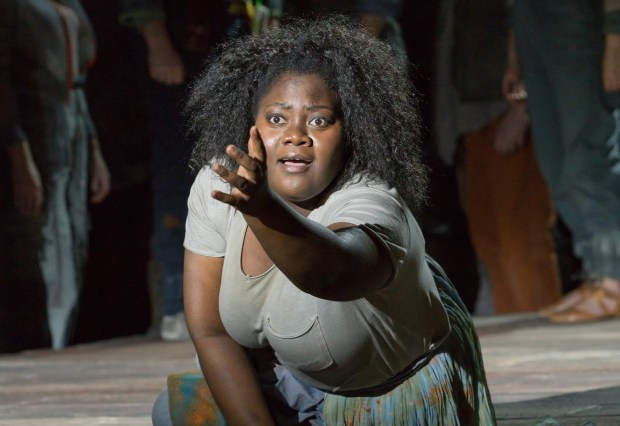
The Biblical story of Susanna is very timely. A beautiful woman in a happy marriage is targeted by two powerful elders in her community while her husband is away. When she rejects their sexual advances, they revenge themselves by publicly accusing her of adultery with a mysterious third person, destroying her reputation and bringing shame upon her family. She is condemned to death but, in the nick of time, is rescued by the youthful prophet Daniel, who interrogates the elders, exposing inconsistencies in their stories. Susanna is vindicated and the two elders condemned to death in her place. At the risk of sounding frivolous, this is the #MeToo oratorio, and any director handling the story in the present climate will be forcibly aware of the parallels. This new production from the Royal Opera House, which features singers from the Jette Parker Young Artists programme, is a little too eager to demonstrate its social conscience. It tackles not only the sexual exploitation of women (as expected) but also (less logically) the climate crisis. The result is weighed down by concept, which – at least on the first night – risked distracting attention from the grace and variety of Handel’s music.

Continue reading