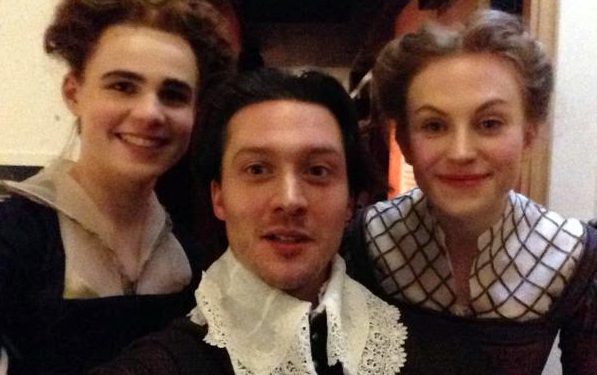
Research in Action: Performing Gender on the Indoor Stage

Performing Gender: Shakespeare's Globe

(Sam Wanamaker Playhouse, 7 May 2015)

We all know that in Shakespeare’s day women weren’t allowed on the stage. Recently several productions have tried to recreate the flavour of those original performances: Mark Rylance’s Twelfth Night and Richard III productions come to mind. But even these don’t give an accurate flavour of what Elizabethan and Jacobean audiences would have seen. Female roles were played by young boys aged between 12 and 22 years old, highly skilled actors who would specialise in playing women until at a certain stage they were no longer able to convince with the illusion (many ended up transitioning across the gender divide and took on male roles within the company).

Continue reading

Pope Joan (1996): Donna Woolfolk Cross

★★★

I’d been keen to read this novel for over a year, so it felt like destiny when I spotted it in my local second-hand bookshop. The shadowy figure of Pope Joan has intrigued me ever since I first heard about her at university: the woman who disguised herself as a man and rose to the highest, most sacred position early medieval Europe could offer, before being unmasked when she gave birth to a child. Cross’s novel, set in the 9th century when Europe was still being forged out of a struggling mass of tiny princedoms and counties, takes in the wild snowy forests of the north, Rome’s faded glory, battles, Viking attacks and a protagonist who had the potential to be one of the most gripping characters I’ve read about for a long time. But unfortunately it never quite gelled into a satisfying whole.

Continue reading

Hild (2013): Nicola Griffith

★★★★★

A Novel

This was a rare thing: a book I came to on the strength of its subject, knowing nothing about its author, hoping that it would be a amusing read – only to find myself simply blown away by the quality of the writing. And I’m not easy to impress. All I knew at first was that this covered the same period as the excellent The King in the North, which I enjoyed so much. It has turned out to be just as brilliant, in a rather different way. This is a splendid treat of historical fiction, embracing the experiences of both men and women through the story of one remarkable protagonist.

Continue reading

Cry to Heaven (1982): Anne Rice

★★★★

First things first: just in case you jump to conclusions on seeing Anne Rice’s name, or the design of the current book cover on Amazon, this is not about vampires. This is one of her earlier books, published after Interview with the Vampire but before the rest of the Vampire Chronicles, and it is pure historical fiction. Moreover, it deals with a subject that (as far as I know) has been very rarely covered in fiction, with the one notable exception of de Balzac’s Sarrasine: the tragic and breathtaking phenomenon of the castrati.

Continue reading

Twelfth Night (1601-2): William Shakespeare

Twelfth Night: William Shakespeare

★★★★½

(Apollo Theatre, London, playing in rep with Richard III until 9 February 2013)

I should, of course, have seen these plays the other way round: Twelfth Night in early January and then Richard III last night, spiced with the news that the skeleton found beneath a car park in Leicester is (almost certainly) that of the king. Anyway, it was a joy to return to the Apollo for my second encounter with the Globe company in their winter quarters. Once again I hung over the balcony watching the actors milling around as they were dressed, watching doublets and hose tugged on, bodices laced up, lead-white paint and rouge applied to faces. Even without their wigs, the actors gained a feminine elegance as soon as they were into their skirts; and I watched Mark Rylance’s hands fluttering convulsively as he was laced up, as if trying physically to shake himself into his role.

Continue reading

Cinderella Ate My Daughter (2011): Peggy Orenstein

★★★½

Dispatches from the front lines of the new girlie-girl culture

Although it was only published in 2011, Peggy Orenstein’s book has already acquired legendary status in certain circles. Her focus is primarily on girls aged between about three and ten. Her mission is to draw attention to the fact that these modern girls grow up surrounded by increasingly gender-stereotyped marketing, which offers a dismally restricted range of role models and aspirations. Orenstein argues that the apparently innocuous ‘princessification’ of little girls gives them a limited sense of their own potential and that a generation is growing up which has learned to value itself not on its brains or its courage but on how pretty it is.

Continue reading