L’Incoronazione di Poppea (1643): Claudio Monteverdi

Sarah Connolly

(Barbican, Academy of Ancient Music with Robert Howarth, 4 October 2014)

★★★★

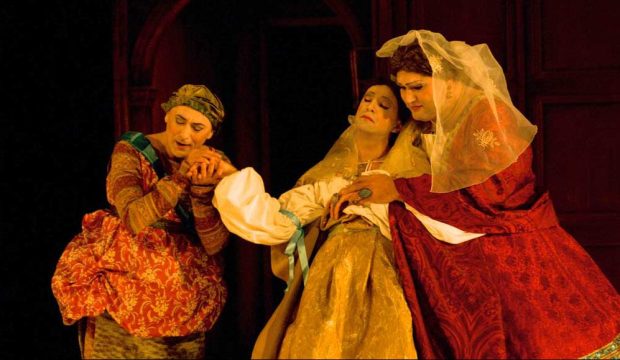
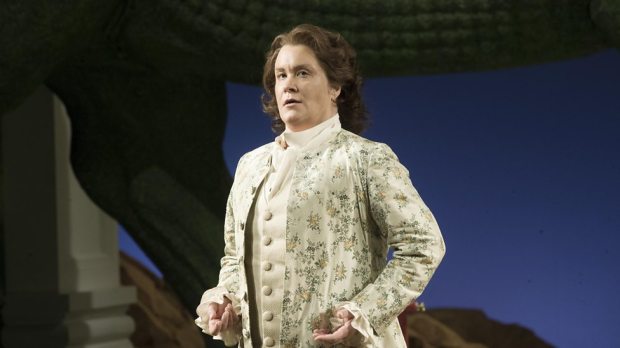
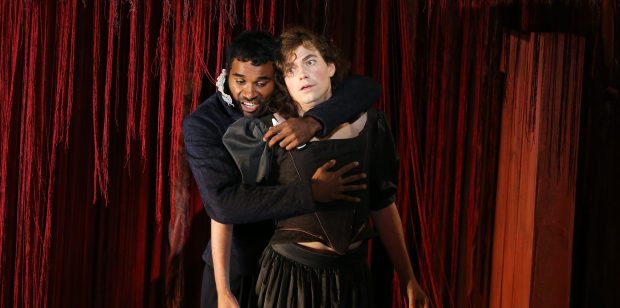
When a friend asked if I wanted to see Monteverdi’s Poppea at the Barbican on Saturday, I said yes immediately. Poppea is a landmark in the history of opera: the first to weave a story around historical characters rather than myths or saints. I’ve only seen one production so far: the version directed by William Christie, with Philippe Jaroussky as Nerone, Danielle de Niese as Poppea and Max Cencic as Ottone. I haven’t written about it yet because I’ve been biding my time until I felt I had a better understanding of it; and this semi-staged version at the Barbican was the perfect way to put the Jaroussky version into context. Its abiding legacy will be a couple of extremely strong performances which I can use as a benchmark in the future.
Continue reading

Xerxes (1738): George Frideric Handel

Handel: Xerxes

★★★★

(English National Opera with Michael Hofstetter, until 3 October 2014)

This was all rather spontaneous. Having heard good things about the ENO’s current production of Handel’s Xerxes, I managed to get a last-minute ticket up in the balcony for Friday night and headed off for my inaugural Handel opera. It wasn’t at all what I was expecting it to be like. It was lyrical rather than bombastic; humorous rather than noble; and full of the kind of bubbly wit that made it feel disconcertingly like The Marriage of Figaro. I knew virtually none of the music: the only aria I had to hand on my tablet was Se bramate d’amar vi chi sdegna from Cencic’s Handel album. It turned out of course that I knew another aria as well: it was a bit of a surprise when the opera opened with Ombra mai fù. (No, I didn’t know it was sung to a plane tree either: you learn something every day.)

Continue reading

Elena (1659): Francesco Cavalli

Cavalli: Elena

(Aix-en-Provence, 2013, with Leonardo García Alarcón and Cappella Mediterranea)

How do I begin to describe Elena? It definitely isn’t your average opera. Imagine a Baroque cross-dressing operatic romantic comedy, with importunate lovers (plenty), pirates (sort of) and bears (briefly). How can you refuse something so gloriously over-the-top? Performed with gusto by a brilliant young cast, many of whom have since made names for themselves all over Europe, this charming, rambunctious, occasionally downright daft production from the Aix Festival is in a genre all by itself.

Continue reading

Sant’ Alessio (1632): Stefano Landi

Landi: Sant' Alessio

(Théâtre de Caen, Les Arts Florissants with William Christie, 2007)

★★★★ ½

Over the weekend I treated myself to another opera DVD, this time one which transported me back to the very earliest days of the art form, to Rome in 1632. At this date the Counter-Reformation was in full swing and the Baroque was just coming into being. Gianlorenzo Bernini, who would become the supremo of 17th-century Rome, was 25 and had been asked to design the stage set for Stefano Landi’s new religious oratorio Sant’ Alessio. The production available on this DVD attempts to recreate the feel of that first performance and I admit I came to it with some trepidation. This all felt a very long way from the exuberance of the 18th century.

Continue reading

Artaserse (1730): Leonardo Vinci

Vinci: Artaserse

★★★★★

(with I Barocchisti [CD] and Concerto Köln [DVD], directed by Diego Fasolis, 2012)

Before we start, I should emphasise: the composer is not the artist Leonardo da Vinci (1452-1519), but a completely different person, the Neapolitan Leonardo Vinci (1690-1730). I must also add a disclaimer. As you may remember, I know nothing about the technicalities of music. In this field I am, more than ever, merely an enthusiastic amateur. That’s especially the case in Baroque music, which must be one of the most technically complex and elaborate areas of classical music. However, as I’ve said before, I’m fascinated by the phenomenon of the castrati and, as such, this particular opera (and performance) was one I couldn’t resist.

Continue reading

The Turn of the Screw (1954): Benjamin Britten

Britten: Turn of the Screw

★★★★

(Glyndebourne, 11-28 August 2011)

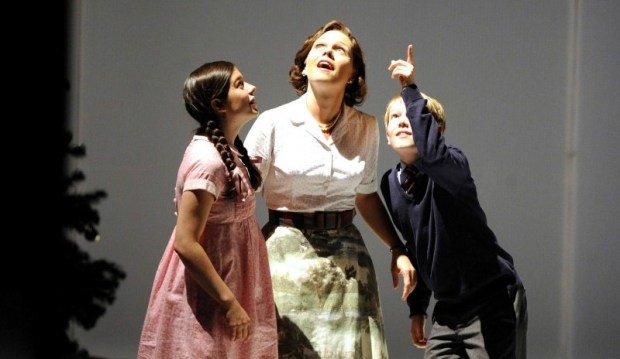
I have a huge debt of gratitude to repay to my friend who, on being given three tickets for this performance (the original purchaser having fallen ill), asked me to come with her. Glyndebourne is a remarkable experience and, for us, it was a brief glimpse into another, gilded, world.  As evening dress is traditional, it was easy to spot our fellow festival-goers on the 14:47 from Victoria.  Well-heeled couples carried Fortnum & Mason hampers and groups of young men, who might have stepped straight out of Brideshead Revisited, lounged in the aisles toting picnic rugs and bottles of champagne.  At Lewes station we all piled out of the train and onto some waiting coaches and then we rattled through narrow winding streets (it’s a picturesque little town; I’d never been before) to the house itself.

Continue reading