The Hobbit: An Unexpected Journey (2012)

The Hobbit: An Unexpected Journey

★★★½

(directed by Peter Jackson, 2012)

On a chilly evening last Sunday in Leicester Square, waiting for the doors of the Odeon to open, I found it hard to believe that eleven years have passed since The Fellowship of the Ring came out. A fair amount has happened in those years, but in this moment they ceased to exist: the prospect of spending an evening in Peter Jackson’s version of Middle Earth made me feel as if I were sixteen years old all over again.

Continue reading

Pompeii (2003): Robert Harris

★★★½

Attilius is an aquarius: a specialist engineer who constructs and maintains the great aqueducts that feed the Roman Empire. His first significant posting is to Misenum, the great naval base at the tip of the Bay of Naples and the terminus of the immense aqueduct, the Aqua Augusta, which waters the resorts and towns around the bay. Attilius’ predecessor, the aquarius Exomnius, has vanished in mysterious circumstances; but nobody admits to knowing where he’s gone. And anyway Attilius has more pressing matters on his hands: his gang of recalcitrant workmen don’t take him seriously; his foreman Corax does all he can to undermine his authority; and the waters of the Aqua Augusta have begun to fail.

Continue reading

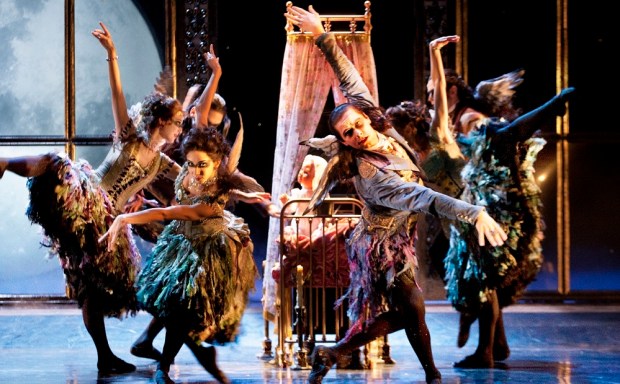
Sleeping Beauty (2012): Matthew Bourne

Sleeping Beauty: Matthew Bourne

★★★★½

(Sadler’s Wells, London, until 26 January 2013)

Generally speaking I find ballet to be a foreign country: I can appreciate its beauty but I simply don’t speak the language needed to feel entirely at home there. I can appreciate the sweeping vistas of tulle and the exaggerated gestures, but when I was younger they only emphasised the strangeness of this art form, which was clearly something for an initiated elite – of which I was not a member.

Continue reading

The Diviner (2011): Melanie Rawn

★★★

As you may remember from my recent post, The Golden Key was one of my favourite books of my teenage years and I could hardly believe my luck when I stumbled upon Melanie Rawn’s recently-published prequel, The Diviner, in a local charity shop last weekend. You might recall that The Golden Key was a remarkably successful collaborative work between Rawn and two other writers, Jennifer Roberson and Kate Elliot. I read somewhere that the authors had planned to write a prequel trilogy, taking one book each (that was probably on Wikipedia: let’s be honest about the standard of my sources).

Continue reading

Hollywood Costume (2012-13)

Hollywood Costume

(Victoria & Albert Museum, until 27 January 2013)

The V&A have assembled more than 100 of the most famous costumes in film history for their winter exhibition, which is unsurprisingly very popular and consequently very crowded. The selection seems to have been guided by no real principle, beyond the admirable one of trying to include examples from as many different genres and periods as possible. The purpose of the exhibition is to use these outfits as a framework, to educate the general public about the process of designing costumes for the movies.

Continue reading

The Lessons (2011): Naomi Alderman

★★★★

Last time I went to the library, this book was one of the spoils that I carried off: in retrospect, it’s odd that  I hadn’t read it before. Perhaps it’s simply that I wasn’t familiar with Alderman’s writing. Her first novel Disobedience had very good reviews but I’ve never got round to reading it; and I remember having picked up The Lessons somewhere before, but only for long enough to read the prologue, which didn’t do much for me. I wish I’d persevered.

Continue reading

Vikings: A History (2012): Neil Oliver

★★★★★

This post comes with a warning for overbubbling enthusiasm; but I just can’t help myself. I didn’t watch Neil Oliver’s BBC series on the Vikings, but when I spotted this companion volume, on the Book People’s stall during a Christmas fair at work, it was difficult to resist. The Vikings, like the Romans, are a shadowy but constant presence in British history and yet I don’t know as much about them as I would like.

Continue reading

Miranda (2009)

Miranda

★★★½

Although I have a television, I don’t watch it much and so I’m usually hopelessly behind with the latest hit series. Just look at how long it took me to get into Sherlock, for example. With Miranda, however, I’m even further behind. Series 1 was aired in 2009 and Series 2 in 2010, but I knew virtually nothing about it, beyond the fact my parents had seen some of the episodes and found it amusing. (I only knew that because my mother started pouncing on every time I said ‘such fun’ in the course of a conversation, and had to explain herself.)

Continue reading

Baudolino (2000): Umberto Eco

★★★½

This was a reread, but it might as well have been a first encounter: I’d read Baudolino back in spring 2004 and remembered virtually nothing of the plot, beyond my delight that Niketas Choniates was one of the main characters. Yes, I probably do need to explain that. By sheer chance, I’d begun to read this novel after a term spent studying medieval European history, during which one of my essays had required me to spend a week getting my head around the mechanics of the Byzantine court. I didn’t really manage it, but it sparked off my fascination with Byzantium and, even better, it introduced me to Niketas. His Annals include what has become one of my favourite historian quotes: ‘There can be no one so mad as to believe there is anything more pleasurable than history.’ Bravo that man.

Continue reading

Scaramouche (1921): Rafael Sabatini

 ★★★½

Sometimes, on opening a book for the first time, you find a phrase that makes you sigh contentedly, settle down and think, ‘Oh, yes.’ I had never read anything by Sabatini before and yet, when I read this novel’s opening line – ‘He was born with a gift of laughter, and a sense that the world was mad‘ – I knew instinctively that we’d get along well. With an avowed weakness for adventure, derring-do and the buckling of swashes, I’m amazed that I didn’t stumble across Scaramouche years ago. It was only when Helen mentioned it, in her post on The Prisoner of Zenda, that I realised it was something I’d enjoy.

Continue reading