Lullaby (2016): Leïla Slimani

★★★½

Quis custodiet ipsos custodes? Leïla Slimani’s bestselling novel evidently strikes a chord with its readers and it isn’t hard to see why. It plays on the deepest fears that any parent can have. What if our children are most at risk from those we’ve hired to care for them? On the very first page, we’re shown a horrific scene: two children brutally murdered, their nanny lying with self-inflicted wounds beside them. It’s a shocking, apparently senseless crime. But then Slimani takes us back, to tell the story of the family, the nanny and the children. Her novel raises uncomfortable but necessary questions about domestic service, modern parenting, class, and the desire to be needed.

Continue reading

Ransom (2009): David Malouf

★★★★

This book has been on my to-read list for a very long time. Such anticipation can lead to disappointment if a novel fails to meet expectations; but this one turned out to be well worth the wait. Simple and yet deeply poetic, it tells the story of an old man – Priam, King of Troy – who sets out to ransom back his son Hector’s body from the man who has killed him – Achilles, the ruthless warrior par excellence. Malouf’s book goes beyond the story as related in the Iliad, probing questions of majesty, nobility and, most importantly of all, humanity. Elegant and poignant, it centres on a moment of unforeseen compassion in the heat of war and breathes new life into its two famous protagonists.

Continue reading

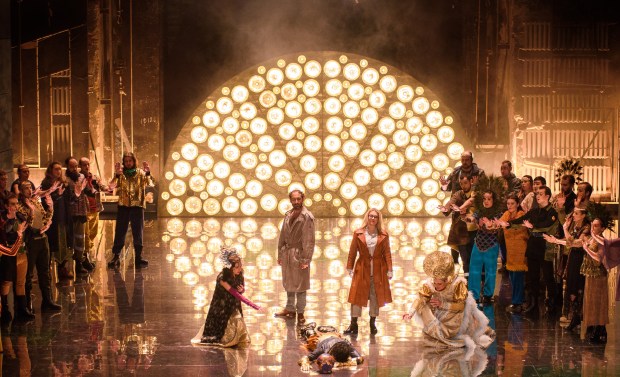
Phaéton (1683): Jean-Baptiste Lully

Lully: Phaéton

★★★½

(Opéra Royal de Versailles, 30 May 2018)

When business took me to Versailles this week, I just happened to arrive on the first night of the Opéra Royal’s new production of Lully’s Phaéton. As you know, French Baroque opera is still something of a terra incognita for me, so I decided to see if there were tickets available, and discovered a last-minute return. It would’ve been rude not to. That evening, perched in a velvet-lined box, with gold and glittering crystal overhead, I settled in for an epic four-hour tale of ambition, love and hubris. It was a steep learning curve, with marked differences from the Italian operas that I know and love, but I can’t think of a better place to experience the Sun King’s composer for the first time, and the production was blessed with a terrific performance in the title role by Mathias Vidal. So join me, as I bumble my way through this first extended encounter with Monsieur Lully…

Continue reading

Friend Request (2017): Laura Marshall

★★★

Occasionally we all get moments, perhaps after reading a surfeit of very serious Russian short stories, when we’d quite like to read something a little less demanding. So it was that this much-publicised thriller arrived on my Kindle. I’d spotted posters for Friend Request all over the Tube a few months ago and the premise intrigued me. What would you do if you had a Facebook friend request one morning from an old classmate whom you believed to have died twenty-five years before? (Personally I wouldn’t accept it and would report it to Facebook; but I suppose that’s why I’m not the protagonist of a thriller.) It was a tantalising, eerie scenario. I plunged into the story with gusto, reading it in an afternoon, but, maybe inevitably, it didn’t quite live up to expectations. A taut tale of rising tension is muddied towards the end by too many plot strands and a much-hyped twist that felt more melodramatic than plausible.

Continue reading

The Belt of Gold (1984): Cecelia Holland

★★★★

When Hagan and his brother Rogerius arrive in Constantinople in 802, on their way home to Frankland from Jerusalem, they see it only as a stop on their journey. They have fulfilled their pilgrimage and now look forward to resuming their lives among the mists and forests of their native country. But when an accidental encounter with a beautiful young woman and a gang of thugs leaves Rogerius dead, the heartbroken Hagan vows revenge. Little does he realise that this vow will draw him deep into the midst of the literally byzantine plots unfolding in the Queen of Cities, and entwine his future with that of the beautiful, charismatic, dangerous Empress Irene.

Continue reading

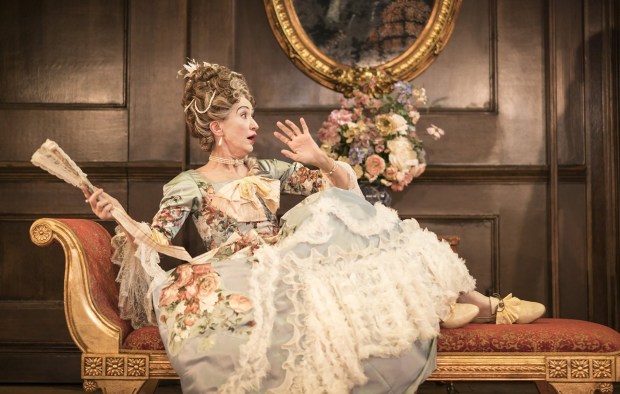
The Way of the World (1700): William Congreve

The Way of the World

★★★★

(Donmar Warehouse, 25 May 2018)

Midway through last week, I saw that Kerstin had posted on Facebook about William Congreve’s The Way of the World, first performed in 1700 and now playing in Covent Garden once again, this time in the cosy Donmar Warehouse. I was sorely tempted, as I hadn’t seen a Restoration comedy for years. By chance there was a single seat left on Friday night; and so off I went, for a thoroughly self-indulgent evening of belles, beaux, dastardly rakes, romantic dowagers, wicked stratagems and – I devoutly hoped – virtue rewarded. Although it sometimes proved difficult to fathom exactly who was gulling whom at any given moment, I had a wonderful time, savouring the dazzling costumes and the accomplished cast, who brought out all the sparkle of Congreve’s elegant wit.

Continue reading

Girl Meets Boy (2007): Ali Smith

★★★

People have been telling me to read Ali Smith for years, but I haven’t yet got round to any of her novels, not even How to Be Both, which has been urged enthusiastically on me by my friend I. However, I hope to exculpate myself now, because I’ve finally embarked on Smith’s oeuvre in the form of Girl Meets Boy, one of the Canongate Myths series. I found it charming, if not overwhelming: it’s a sweet story of first love and how to have courage; a dreamlike tale of how we love most truly when we love the person rather than the outward shell. Based on Ovid’s story of Iphis, it uses the Scottish city of Inverness as the stage on which to thumb its nose at gender norms.

Continue reading

Bite-Sized Russians

Bite-Sized Books

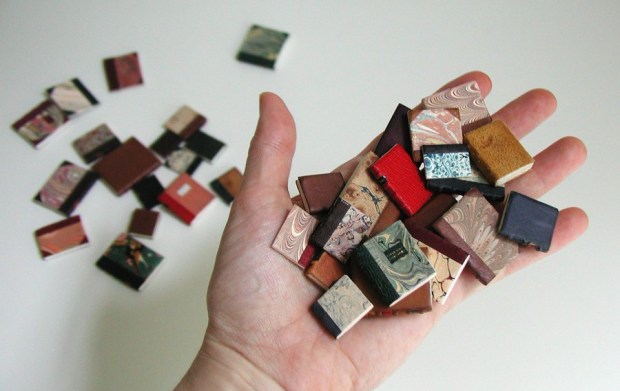
Penguin’s Little Black Classics series includes a number of works by Russian writers, who haven’t figured very prominently in my reading to date. It was time to correct that. These short stories gave me the chance to have brief encounters with Pushkin, Dostoevsky, Gogol and Chekhov, none of whom I’d read before, as well as renewing my acquaintance with the towering Tolstoy. It has felt rather like speed-dating with Russian authors. Along the way I’ve been introduced to ambitious officers, unhappy wives, unscrupulous peasants, mentally unstable dreamers and an errant nose with a penchant for disguise. My appetite has certainly been whetted and, in due course, I’ll be looking into some of these authors in greater detail. By the way, I must stress that I’m well aware Gogol is Ukrainian by birth, but I hope I can be forgiven for including him here, as he’s often cited among the great Russian-speaking writers. Now, don your fur hat, grab your tot of vodka and hie ye to your troika, as we delve into the 19th-century Russian mind…

Continue reading

So You’ve Been Publicly Shamed (2015): Jon Ronson

★★★★

We can all agree that there are some pretty terrible people in the world; but they’re rarely the people you see being publicly eviscerated on Twitter. Those who face the onslaught of social media are rarely murderers, child abusers, dictators or other bona fide nasty types. They’re far more likely to be celebrities, or even ordinary people, who’ve made a stupid comment or worn a misguided piece of clothing and have consequently become Public Enemy No. 1 for the next day and a half. We’ve all seen these furies explode on Twitter and then die off within a week, when the next big thing turns up. But the impact of this public annihilation doesn’t disappear so easily. Jon Ronson sets out in search of those who’ve been publicly shamed, seeking to understand why it happened, what it felt like, and how – and if – one can recover from it.

Continue reading

The Radleys (2010): Matt Haig

★★★

Nothing much ever happens in the Yorkshire village of Bishopthorpe. That’s exactly why the Radleys moved there from London before their children were born. With their unremarkable middle-class villa, their predictable middle-class people-carrier, their unobjectionable middle-class existence, their book clubs and their Sunday dinners, and their two shy and rather sickly teenage children, Helen and Peter Radley are barely worth a second glance. And that’s the way they like it. Unfortunately, their children are getting to a difficult age and events soon rapidly spiral out of control. It turns out that teenage self-discovery is much harder to handle when your entire family are vampires.

Continue reading