Tench (2015): Inge Schilperoord

★★★★

How do you become the person you want to be? This is the challenge that faces thirty-year-old Jonathan when he is released from prison, acquitted on the basis of insufficient evidence. He returns to his elderly mother and their isolated house on the edge of the dunes, one of only two houses left standing in the midst of demolition. Soon the council will rehouse them on a new estate, but Jonathan isn’t looking forward to it. Change upsets him. And so he tries to settle back into his old life: long walks on the dunes with the dog; watching TV with his mother; fishing in the ponds. He wants to be good. But, as summer thickens over their dead-end town and the mercury rises, Jonathan finds his calm unsettled by the bright, creative, clever little girl next door. Sometimes instinct can undermine even the best laid plans.
Continue reading

Call Me By Your Name (2017)

Call Me By Your Name

★★★★

(directed by Luca Guadagnino, 2017)

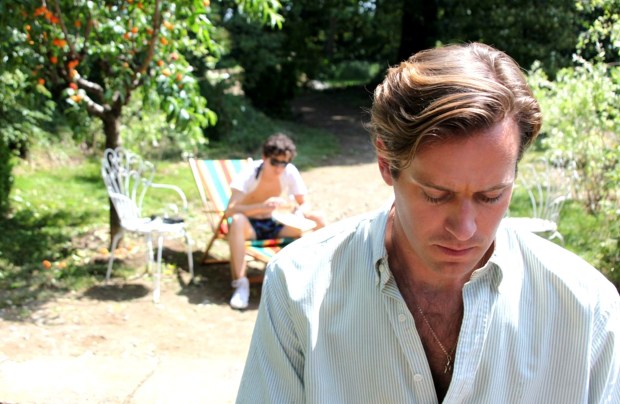
All right, I couldn’t resist. With the book fresh in my mind, I decided to treat myself to the opening night of Call Me By Your Name and savour some Italian decadence. I wasn’t quite sure what to expect, as I’ve seen Guadagnino’s I Am Love and found that too self-consciously arty; but I needn’t have worried. This film was predictably stuffed with beauty (both human and natural), drenched in Mediterranean languor and blessed with a stunning central performance from Timothée Chalamet as Elio. Playful and poignant by turn, this is the love affair we all wish we had when we were seventeen (‘Grow up. I’ll see you at midnight‘).

Continue reading

Call Me By Your Name (2007): André Aciman

★★★★½

First loves are powerful things. They haunt us for years and we can never quite shake off the memory of them, nor the deep ache they seem to cause. The film adaptation of this novel will be released tomorrow and is already causing critical waves, but I’m so glad I came to the book first. It is a poignant, intimate, irresistible story of a love affair which develops during an idyllic Italian summer between the precocious son of a college professor and his father’s visiting student. In one sense, it is a comfortable tale of beautiful, privileged people falling beautifully in love in beautiful surroundings; but in Aciman’s hands it becomes much more than that. Told in seventeen-year-old Elio’s pitch-perfect narrative voice, it’s a catalogue of human desires, flaws, hopes and lost dreams, so sumptuous that it leaves you aching with nostalgia and feeling drunk on beauty.

Continue reading

Sylvester (1957): Georgette Heyer

★★★★½

Or, The Wicked Uncle

Things are busy at the moment and I don’t have much brain space to spare, so I turned gratefully to the next novel on my Georgette Heyer pile. This was Sylvester, which several people have picked out as one of their favourites. And it’s no wonder: it’s vintage Heyer, the literary equivalent of crumpets by a roaring fire on a winter’s night. From the moment our arrogant but misunderstood hero meets our stubborn, bookish heroine, there’s no doubt what’s going to happen, but that’s not the point. As they lock horns over the course of a book stuffed with warmth, wit and adventure, the question isn’t ‘what?’ but ‘how on earth?’. In my current state, it was exactly what I needed and I might even go so far as to name this my favourite Heyer after the nonpareil These Old Shades.

Continue reading

The Humans (2013): Matt Haig

★★★★

Professor Andrew Martin is, for one dazzlingly brief moment, the most brilliant man on the planet. The next, he has vanished off the face of the earth. Unfortunately for Andrew Martin, we’re not alone. You see, all those people who wondered if there was intelligent life elsewhere in the universe were absolutely right. They were just wrong when they assumed it’d want to get in touch with us. Or, more specifically, that said intelligent life would want us to get in touch with it. And so, when Andrew Martin solves the Riemann hypothesis and holds the secret of exponential human advancement in the palm of his hand, the watching extraterrestrial lifeforms decide that he must be stopped.

Continue reading

Lavinia (2008): Ursula Le Guin

★★★½

As a child, I read Ursula Le Guin’s Earthsea Quartet, which I loved for its wizards and fantasy (I hope to reread it soon). In my early twenties, I read her Left Hand of Darkness, which was one of the first books that made me think seriously about gender. And now I’ve turned to what I thought would be a comparatively straightforward historical novel: her book about Lavinia, princess of Latium, who becomes the wife of Aeneas. But Le Guin is never simple. Her Lavinia is a bright, demanding person: full of questions. She probes at the limitations of the way she has been preserved for posterity, rebelling against the strictures of a poem in which she doesn’t even get to speak. Playful, intelligent and just a little bit angry, this novel reimagines one of the great epics of the Western tradition. Le Guin, and Lavinia, take Virgil to task for his omissions but this isn’t just a scolding. It’s also a great love letter from one author to another: a tribute to the power of story-telling, which can give the figures of the past a voice.

Continue reading

Prince of Thorns (2011): Mark Lawrence

★★★★

The Broken Empire: Book I

Apologies for the unintentional hiatus on the blog (The Silent Companions was a scheduled post and rather took me by surprise). I’m in the middle of a frantic time at work and so I’ve neither been reading nor writing as much as I would like. However, I have managed to work my way through a few non-art-related books recently and wanted to share them, because they’re rather good. I’m starting off with my first encounter with Mark Lawrence, the godfather of grimdark, whose name has come up repeatedly since I started reading Joe Abercrombie and Anna Smith Spark. And the recommendations have been absolutely spot-on. I thoroughly enjoyed it. Gripping, bleak and brimming with black humour, it’s a classic revenge story and features a teenage antihero so twisted he’d send Joffrey Baratheon running for the hills.

Continue reading

The Silent Companions (2017): Laura Purcell

★★★½

When a young widow travels to her dead husband’s family home, after only a few months of marriage, she believes that her greatest challenge will be in mastering her grief. But The Bridge is an unsettling place: a rambling old house, unloved and worn, with a meagre staff of taciturn servants and a history of unpleasant accidents. This is a Gothic tale of a slow, creeping kind, best savoured on a dark winter’s night beside the fire, in which supernatural events sit side by side with very real social tension.

Continue reading

Deerskin (1993): Robin McKinley

★★★½

Fairy tales were originally born as dark things, a world away from the pastel-coloured sugar of Disney’s princesses, and they weren’t always meant for children. They were ways of rationalising the brutalities of life, of creating a happy ending beyond the horrific events that might be suffered. Fairy tales deal with infanticide, child mortality, forced marriages, murder and child abuse and yet Robin McKinley’s Deerskin is based on a tale (Donkeyskin) deemed so particularly unpalatable that it’s rarely published, even though it was originally written by Charles Perrault. With grace, sensitivity and compassion, McKinley turns this little-known story into a powerful tale of self-healing.

Continue reading

Half a War (2015): Joe Abercrombie

★★★½

The Shattered Sea: Book III

I’ve thoroughly enjoyed Joe Abercrombie’s young-adult trilogy, which I’ve used as a way to ease myself into the considerably grimmer and darker world of his adult novels. This concluding instalment of the Shattered Sea trilogy already breaches some more troubling themes than its predecessors. This is a tale of blood and senseless slaughter; of moral decisions taken by the immoral. It’s a story which represents the truly brutalising force of war: not that men and women lose their lives, but that they lose their honour and their humanity in thrall to weapons more powerful than themselves. Inventive to the last, Abercrombie’s world turns established fantasy on its head and left me grinning at its impudent audacity.

Continue reading