Affinity (1999): Sarah Waters

★★★★

Sarah Waters’s novels have impressed me so much more than I expected. Before I read The Paying Guests earlier this year, I had her down as an author who did naughty ladies in corsets, but now that I’ve actually started making my way through her books, I’ve realised how reductionist that was. Affinity has yet again proven her remarkable ability to capture a time and place, this time the curious world of Spiritualism in Victorian London. Deftly unsettling and almost Hitchcockian at times, it’s a fine piece of work, if somewhat more unstated than the tumultuous antics of Tipping the Velvet.

Continue reading

The Power (2016): Naomi Alderman

★★★★

On one otherwise unremarkable day, something starts to happen that will change the world. One by one, fifteen-year-old girls all over the world discover a strange crackling sensation in their fingertips. One by one, they discover that their maturing bodies allow them to manifest sparks of electricity that can be thrown from hand to hand, transmitted through water and used as a weapon. Suddenly, women can harm or kill men with barely a second thought. The girls discover that, through their touch, they can activate the same power where it lies dormant in the bodies of older women. As society teeters on its foundations, a handful of very different women – and one man – find themselves at the heart of the storm, as they try to harness and understand this critical biological development.

Continue reading

The Ornatrix (2016): Kate Howard

★★★

Flavia knows she is ugly. It is the one constant in her life and, because of it, her mother resents her, her father pities her, and her younger sister Pia steals all the glory, savouring the betrothal and marriage night that Flavia herself will never have. With a purple birthmark in the shape of a bird soaring across her cheek, Flavia is irrevocably marked. And yet, when her vindictive behaviour leads her parents to wash their hands of her at last, and confine her to a convent, Flavia discovers a remarkable truth: beauty can be assumed. Assigned to the elegant Ghostanza Dolfin, serving as her ornatrix or beautician, Flavia discovers that beauty can come out of a jar and that ugliness can be hidden beneath the glowing white mask of cerussa. Suddenly, life is full of possibility.

Continue reading

The Hidden People (2016): Alison Littlewood

★★★

I was intrigued by the premise of this novel. In the 1870s, a young woman is horribly murdered after her husband and neighbours take her for a fairy changeling. Stung into action, her London cousin comes north to Yorkshire to challenge these country superstitions and to uncover what really happened to little Lizzie Higgs. Having just finished reading The Essex Serpent, I hoped for a similarly deft conflict between popular belief and scientific reason. This juxtaposition is at the heart of the novel, but it didn’t quite pan out as expected. Instead, the book ambitiously tried to combine several genres – crime, fantasy, horror, supernatural and psychological thriller – without ever really committing to any of them.

Continue reading

The Essex Serpent (2016): Sarah Perry

★★★★

In 1893, the mysteries of the world are on the brink of being solved. Fossil hunters claw the remains of prehistoric beasts from the cliffs of southern England. The safe securities of Biblical history are brought into question by the realisation that the earth is far older and wilder than had ever been imagined. And yet all the reason in the world can crumble in the face of superstition. Down in the marshes and estuaries of Essex, something moves in the dark waters and legends of a half-forgotten, terrifying beast start to surface once again.

Continue reading

Esther (1950): Norah Lofts

★★★½

My enduring mission to hunt down fiction set in Achaemenid Persia brought me to this book: a retelling of the story of Esther by Norah Lofts, who impressed me with her King’s Pleasure. Expressly aimed at teenage readers, it’s a charming little book which conveys both Esther’s intelligence and the king’s humanity in a far more effective and engaging way than the painful film One Night with the King. It was so enjoyable, in fact, that I was willing to accept a fairly major historical swerve.

Continue reading

Il ritorno d’Ulisse in patria (1640): Claudio Monteverdi

Monteverdi: Il ritorno d'Ulisse in patria

★★★★

(English Touring Opera at the Hackney Empire, 15 October 2016)

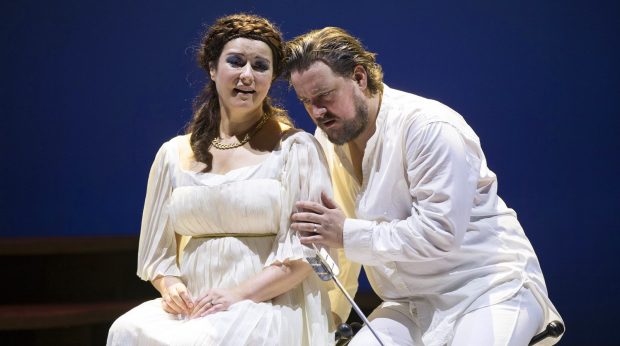
Most operas are about infatuation: the sudden, all-consuming flare of love that causes kingdoms to fall, mountains to crumble and worlds to change – the love of Paris for Helen, for example. We don’t hear quite so often about the quieter, more enduring kind of love that ‘withstands tempests and is never shaken’. Yet here, in his second surviving opera, Monteverdi does just that. His heroes, Ulysses and Penelope, aren’t tumultuous young things: on the contrary, they’re two people of a certain age, trying to make the best of a bad job. It doesn’t sound terribly dramatic, does it? And it isn’t, if by drama you mean fire and the clash of steel. But it’s one of the most moving stories I’ve seen in opera so far, because it takes the power out of the hands of kings and emperors, and lays bare the workings of the human heart.

Continue reading

Calisto (1651): Francesco Cavalli

Cavalli: Calisto

★★★★

(English Touring Opera at the Hackney Empire, 14 October 2016)

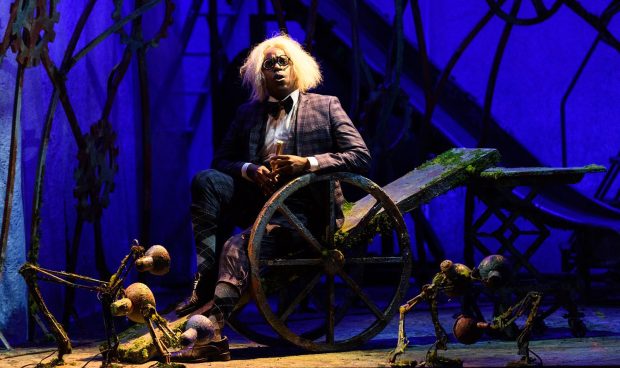
On Friday night it was time for the second opera in ETO’s autumn Baroque trilogy (the first was their Battle of Britain Xerxes). This time we were going back to the mid-17th century for Cavalli’s Calisto, which on the surface is an exuberant pantomime in song about gods behaving badly in the forests of Arcadia. Beneath the raunchiness, however, this opera has a surprisingly radical message. In a fascinating pre-show talk, the director and conductor Tim Nelson explored allusions to Galileo and the defeat of faith by reason, which – if this isn’t just the result of academic over-reading – would make the apparently frothy Calisto a subversive commentary on the biggest controversy of the day.

Continue reading

The Libertine (1994): Stephen Jeffreys

The Libertine: Stephen Jeffreys

★★★★

(Theatre Royal, Haymarket, 22 September 2017)

It is the age of Restoration: of rakes, rogues and wenches, frock coats, billowing cuffs and absurdly large periwigs. Charles II has been on the throne for fifteen years and the age is at its pleasure-drunk apex. Bands of drunken young noblemen riot through taverns and theatres, shaking off the privations of their Puritan youth. Their figurehead is none other than the most lascivious, most scurrilous, most impudent nobleman of all: the Earl of Rochester. He has just been allowed back to court after a previous prank went wrong (accidentally reading out an extremely crude poem in front of the Queen’s visiting relatives), and he is determined to make up for lost time.

Continue reading

The Castrato (2013): Joyce Pool

★★

When I saw that this book was available for advance review, I jumped on it immediately. In theory, this story of a young castrato studying in Florence in the twilight years of the Medici dynasty couldn’t have been further up my street if it had tried. The protagonist is even offered the lead in a Scarlatti setting of Arminio! I looked forward to being immersed in the sensual splendour of Florence circa 1698, rich with art and texture and music, but alas that didn’t happen. In fact, the book turned out to be such a slog that I doubt I’d have finished it if I didn’t have to review it. More unfortunately, I suspect that the real problem here is that of the translator, not the author.

Continue reading