The Prisoner of Zenda (1894): Anthony Hope

★★★½

It’s high time for another swashbuckler, as a busy period looms at work. This time the book in question is a much-loved classic which I should really have read years ago. First published in 1894 (my copy was given to ‘Gladys W. Silva from Dorothy & Jack, Xmas 1895’), this wonderful romp hasn’t aged nearly as much as you might expect. It’s a deliciously fast-paced tale of disguise, secret identities, wicked plots, noble heroes and dastardly villains. Like Scaramouche, this was something that I finally decided to try when I saw that Helen had been reading it (I have to thank Helen for a lot of swashbuckling goodness). That was a full year ago, which gives you some idea of how easily I’m distracted where books are concerned. However, good things come to those who wait…

Continue reading

The Altarpiece (2013): Sarah Kennedy

★★½

The Cross and the Crown: Book I

It is 1535 and Henry VIII, bedazzled by a pair of black eyes, has put aside his wife Katherine of Aragon and turned his back on the Catholic Church in favour of Reform. His sentence falls heavily on the kingdom’s monasteries, which are charged with immorality and avarice, and their rich goods and lands seized for the benefit of the king – or more accurately the benefit of the local lord, should he have the courage to take them.

Continue reading

Earthly Joys (1998): Philippa Gregory

★★★ ½

Moving away from her usual stamping-ground of the Wars of the Roses and the Tudors, Philippa Gregory turns her attention in this novel to a much less familiar aspect of British history: the development of 17th-century botany and horticulture. At its heart is John Tradescant the Elder, the most celebrated gardener of his time, whose life spanned from the twilight of the Elizabethan age to the brink of the Civil War, and who did more than any of his contemporaries to encourage and enrich the love of gardening in England.

Continue reading

A Time of Gifts (1977): Patrick Leigh Fermor

★★★★★

A Time of Gifts: Book I

Back in the summer, when the weather was balmy and the evenings long, I went through a phase of buying travel books (largely because I’d enjoyed Misadventure in the Middle East so much). With their beautifully-designed covers, Patrick Leigh Fermor’s books had caught my eye many a time in Waterstones, but I’d never read any of them. Now, as the wind rattles my sash windows and the nights close in, I took this first book off my shelf, hoping for a bit of escapism. It has turned out to be far, far more than that.

Continue reading

The Cheapside Hoard (2013)

The Cheapside Hoard

(Museum of London, until 27 April 2014)

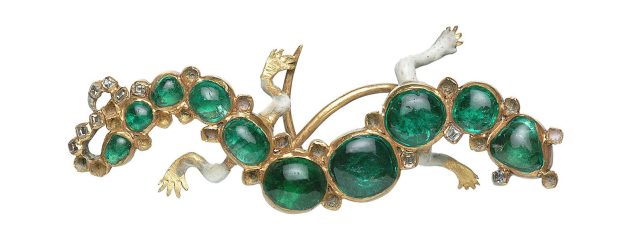
All that glisters is not gold in the Museum of London’s dazzling new exhibition: there are also rubies, emeralds, garnets, diamonds, pearls and cameos, amethysts, rock crystal and sapphires. Discovered just over a century ago, during demolition work on a row of 17th-century houses in the City of London, the Cheapside Hoard is a treasure-trove of more than five hundred jewels, which offer an unparalleled glimpse both of Stuart tastes in jewellery and of the goldsmith’s trade in early modern London.

Continue reading

Lionheart (2011): Sharon Penman

★★ ½

The Angevin Series: Book IV

This is the fourth instalment in Sharon Penman’s series about Henry II, Eleanor of Aquitaine and their squabbling sons, following on from When Christ And His Saints Slept, Time and Chance, and Devil’s Brood. I’ve read all the earlier novels, and I enjoyed them too, but unfortunately Lionheart didn’t quite live up to my expectations. It’s hard to know whether this genuinely is a heavier, more stilted book than the earlier instalments or whether it’s just that I’ve become more demanding about historical novels since I read Devil’s Brood in 2009.

Continue reading

Daumier: Visions of Paris (2013-14)

Daumier: The Sideshow

(Royal Academy, London, until 26 January 2014)

The Royal Academy’s autumn exhibition, nestled up in the Sackler Wing, turns the focus onto Daumier, one of the liveliest and most irrepressible artists of the 19th century. He has always fallen slightly outside my comfort zone and, when I first began looking at his art some years ago, I had the impression that there was something rather hard and cutting about it. That’s probably because I was most familiar with his lithographs, laced with political satire, whereas this show presents a survey of his whole career, deliberately looking beyond the caricatures to bring to light the vein of human sympathy running through his art.

Continue reading

Hild (2013): Nicola Griffith

★★★★★

A Novel

This was a rare thing: a book I came to on the strength of its subject, knowing nothing about its author, hoping that it would be a amusing read – only to find myself simply blown away by the quality of the writing. And I’m not easy to impress. All I knew at first was that this covered the same period as the excellent The King in the North, which I enjoyed so much. It has turned out to be just as brilliant, in a rather different way. This is a splendid treat of historical fiction, embracing the experiences of both men and women through the story of one remarkable protagonist.

Continue reading

Blancanieves (2012)

Blancanieves

★★★★

(directed by Pablo Berger, 2012)

I needed a bit of magic in my life yesterday evening, and this critically-acclaimed Spanish film proved to be just the ticket. LoveFilm really is turning out to be worth its weight in gold, because I’m not sure I would ever have come across this otherwise. For once those who dislike subtitles needn’t worry: this black-and-white marvel is a silent film and the dialogue boards have been translated into English. It’s very much in the tradition of The Artist but somehow purer: this isn’t a film that nudges you to notice how cleverly it does silent cinema; it is silent cinema, accompanied by a pitch-perfect score by Alfonso de Vilallonga.

Continue reading

The Far Traveler (2007): Nancy Marie Brown

★★★½

Voyages of a Viking Woman

I realised that I was going to get along rather well with Nancy Marie Brown when I read the opening sentence of her first chapter: ‘The first time I saw a Viking ship in the water, I was struck with the desire to stow away on it‘. I was immediately charmed. Brown started out as a science writer, but she’s recently had the chance to return to her first love: Norse culture and mythology. Her writing is consequently an appealing blend of specialist and enthusiast.

Continue reading