Goddess (2014): Kelly Gardiner

★★★ ½

Occasionally history renders fiction almost unnecessary. This was especially true in the case of Julie d’Aubigny, who blazed her way through Parisian society in the final years of the 17th century. She was a striking, swashbuckling, cross-dressing contralto; a lover of handsome men and beautiful women; a formidable duellist; and the toast of the Paris Opéra, where she was better known under her husband’s surname as Mademoiselle de Maupin. That’s how I was first introduced to her, by Théophile Gautier, on a sunny afternoon several years ago during a university holiday. At the time I was just charmed by the way that Gautier had created a plot which so cleverly mimicked that of As You Like It (a performance of which is at the heart of the novel), but I had no idea that de Maupin had been a real person. Nor did I have any inkling of her fabulous, roistering life, until I read Gardiner’s engaging book. It’s been quite a revelation, and she has been immediately fast-tracked onto my list of favoured historical ‘uppity women’.

Continue reading

De Vouet à Watteau (2016)

Le Brun: Flora

Un siècle de dessin français: Chefs-d’oeuvre du musée des Beaux-Arts et d’Archéologie de Besançon

(Musée du Domaine départemental de Sceaux, until 12 February 2017)

I should have written about this some weeks ago, but the exhibition is still on for about a month and I’d love to flag this to anyone who might have a chance to see it. While the museum at Besançon is closed for restoration, some of its treasures have gone on tour, including a portion of its superb collection of works on paper.

Continue reading

A curator’s tale

French Portrait Drawings: Exhibition Layout

Or, a newbie’s guide to preparing an exhibition

Last week I wrote about the forthcoming French Portrait Drawings show at the British Museum. Today I thought it might be fun, a few days before it opens on 8 September, to tell you a bit about the planning process from idea to installation, from a very personal point of view. The entire experience was new to me and, since many of my friends don’t seem quite sure what a curator does, I thought this might be of interest.

Continue reading

Cathar (2016): Christopher Bland

★★★

I asked to review Cathar with a hint of trepidation. In recent historical fiction the Cathars, like the Knights Templar, have been appropriated by the religious-conspiracy crowd and I wasn’t quite sure what I was letting myself in for. Fortunately I was pleasantly surprised: there were no secret societies (beyond Catharism itself) and no hint of the Grail. This is pure historical fiction. More than, there’s a lot of genuine history here: it reintroduced me to a crowd of real-life figures whom I last encountered during my history degree in Emmanuel Le Roy Ladurie’s magisterial study of Montaillou.

Continue reading

French Portrait Drawings from Clouet to Courbet (2016-17)

Courbet: Self Portrait

(British Museum, 8 September 2016-29 January 2017)

I’ve been debating whether to write about this exhibition here. In the act of doing so, I’m banishing mystique and bringing the blog and the real world together for the first time; but my desire to write about this show was too strong to resist. It’s my exhibition, you see. I’ve been working on it ever since I joined the British Museum in late 2014 and now, to my mingled delight and terror, it’s on the brink of opening to the public.

Continue reading

The Sun King Rises (2005): Yves Jégo and Denis Lépée

★★

A tale of intrigue at the court of Louis XIV

It’s no surprise, surely, that I asked to review this book. With the promise of intrigue and danger at the court of the Sun King, I thought I was in line for a delectable swashbuckler, which would doubtless be all the more interesting for my recent wanderings around Versailles. If only I had read the back of the book first! Here I would have learned that the intrigue was less courtly than esoteric, and that the book focused on ‘a religious brotherhood, guardian of a centuries-old secret’. Da Vinci Code-shaped alarm bells would have started to ring. However, I didn’t see this and, in the end, this strange hybrid of a book – half channelling Dan Brown, half Dumas – simply ended up feeling rather limp, for all its earnest attempts at adventure.

Continue reading

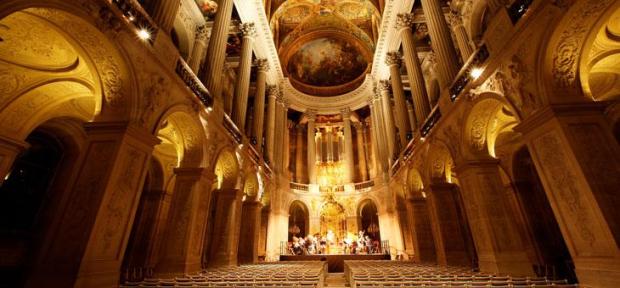
Requiem pour les funérailles de Louis XV (1705/64)

Chapelle Royale, Versailles

(Chapelle Royale, Versailles, 22 June 2016)

What do the composer Jean Gilles (1668-1705), the composer Jean-Philippe Rameau (1683-1764) and King Louis XV (1710-1774) have in common? The answer’s an odd one: they all had the same piece of music at their funerals. This was Gilles’s Messe des Morts, which had its premiere at its composer’s own funeral and remained so popular for the next seventy years that it was reworked and adapted in numerous ways to fit the requirements of later taste.

Continue reading

The Chevalier (2016): M.C. Hobbs

★★½

A recent visit to Netgalley revealed a host of interesting fiction titles, but the one which excited me most on first impressions was The Chevalier, based on the early life of the remarkable Chevalier d’Eon. My interest in the Chevalier was originally piqued when a fictionalised version of him appeared in the BBC’s Scarlet Pimpernel series, and it was revived when the National Portrait Gallery acquired his portrait in 2012. He is one of the most colourful and intriguing figures in 18th-century history and I’m extremely surprised that there aren’t more novels about him. I couldn’t wait to settle down with this. Unfortunately, it didn’t live up to expectations.

Continue reading

Triumph and Disaster: Medals of the Sun King (2015)

Triumph and Disaster: Medals of the Sun King

(British Museum, until 15 November 2015)

When you think of Louis XIV, chances are that you think of Versailles. The Hall of Mirrors; the fountains and festivals; the gold, glass and glitter of the Ancien Régime. But medals? Maybe not. And yet Louis was responsible for one of the most ambitious and innovative of all medal series, the Histoire medallique. Published in 1702, towards the end of his reign, it aimed to celebrate and promote his victories, both as a military commander and an administrator, and to gloss over his defeats and failures.

Continue reading

The Brethren (1977): Robert Merle

Fortunes of France: Book I

First published in 1977, The Brethren was followed by a whole series of novels which trace the fortunes of the de Siorac family in late 16th-century France. The French editions have been tremendously successful and Pushkin published this English translation of the first volume earlier this summer. I was delighted to be invited to review it, partly because it was compared to Dumas and Dunnett, but primarily because the blurb included the word ‘swashbuckling’ and that was too much to resist. There hasn’t been enough swashbuckling around here recently. This must be rectified.

Continue reading