Brilliance of the Moon (2004): Lian Hearn

★★★

The Tales of the Otori: Book III

Spurred on by the desire to find out what happens, and by James’s comment on the last Otori post, I moved on to Brilliance of the Moon: the third and final instalment in Hearn’s series. To some extent it lived up to my expectations, as Takeo is confronted with the five prophesied battles that will shape his future (‘four to win and one to lose‘). The plot picked up its heels as we approached the conclusion; though the actual battle scenes felt rushed and anaemic after all the build-up. And that wasn’t the only problem. The characterisation still had issues and I was left feeling, somehow, unsatisfied. In short, this has been an enjoyable but ultimately flawed series, rich in concept but not always completely successful in execution.

Continue reading

Grass for his Pillow (2003): Lian Hearn

★★★

Tales of the Otori: Book II

After an unconscionable delay of more than a year, I’ve finally got round to reading the second book in this appealing Japanese historical fantasy series. While I didn’t enjoy it quite as much as the first one, this was due to the typical problems facing the middle book of a trilogy. The characters have been separated: the grand opening salvo has already been made; and I presume that Hearn has saved all the set-piece battles for the final novel. Instead, we follow the young lovers Takeo and Kaede on their diverging paths, as Kaede learns to make her way in a male-dominated world, and Takeo seeks to hone his supernatural powers under the guidance of the Tribe.

Continue reading

Anna (2015): Niccolò Ammaniti

★★★½

One thing’s for sure: Niccolò Ammaniti really doesn’t do upbeat. I remember seeing the film Non ho paura, based on his novel, when I was in Sixth Form and I found it unsettling, powerful and profoundly bleak. The same could be said of this atmospheric novel, set in 2020, which explores a world in which adults have been eradicated by a virus and children are left to fend for themselves. There is more than a hint of Lord of the Flies here, but Ammaniti is interested not so much in the innate savagery of children, as in the power of hope to push us onward, through unimaginable horrors.

Continue reading

The Secret Diary of Hendrik Groen (2014): Hendrik Groen

★★★★

Hendrik Groen is 83¼ and lives in a care home in North Amsterdam, but he’s determined not to go gently into that good night. In January 2013 he decides to keep a diary as a way to fight back against the stultifying existence imposed upon him by the director and staff of the home. He firmly believes there’s more to life than having one’s ‘own’ chair in the communal living room; that conversation should be about more than aches and pains; and that the older generation deserves to be given its moment in the limelight. With wit, warmth and poignancy, Groen charts a remarkable year in which he makes new friends, embarks on political intrigue, begins ripping up the road in his new mobility scooter, develops a tendresse for an elegant new arrival and, most importantly, founds the revolutionary Old But Not Dead Club.

Continue reading

The Unknown Ajax (1959): Georgette Heyer

★★★½

When irascible old Lord Darracott announces the imminent arrival of his heir at Darracott Place, his family are somewhat alarmed – not least his son Matthew, who’d assumed that he stood next in line since his elder brothers’ deaths. However, it turns out that he has a previously unsuspected nephew: the offspring of his disgraced elder brother Hugh and a Yorkshire weaver’s daughter. The terms of the settlement don’t allow the family to wriggle out of such a shameful situation, and so the Darracotts close ranks and wait anxiously for their oafish, unknown cousin to arrive…

Continue reading

Gather the Daughters (2017): Jennie Melamed

★★★½

A rustic community on an isolated island: a simple society of farmers, wood-carvers and roofers. The men labour in the fields while the women bring forth children and keep the home; as a woman, one submits first to one’s father and then one’s husband; and, when one’s children have had children and one’s usefulness is outlived, one takes the fatal draught. Nobody questions the laws of the ancestors. It was doubt and sin, after all, which led to the great fire which has ravaged the old world, which is now nothing but a parched wasteland where none but the wanderers may go. Things are as they have always been – as they should be. But, for a group of girls teetering on the brink of womanhood, a dangerous question hovers in the air. Who makes the laws? And what truly lies beyond the island?

Continue reading

Among Thieves (2011): Douglas Hulick

★★★★

A Tale of the Kin: Book I

I hadn’t heard of either the author or the series when I stumbled across this book, but I just couldn’t resist the cover. It’s designed by Larry Rostant, an artist whose work is often informed by some form of historical costume, and which always catches my eye. A brief flick through the novel convinced me it was worth a punt. And it’s been such a delight to read. Full of spies, crime lords, twisted emperors and swashbucklers, it takes you deep into the seething heart of the city of Ildrecca: the kind of place you might come across Locke Lamora having a drink with Don Corleone, Captain Alatriste and Sam Vimes. Best described as historical urban fantasy, it’s a tale of deals and double-crossing, spiced with the smallest hint of magic, and it’s enormous fun.

Continue reading

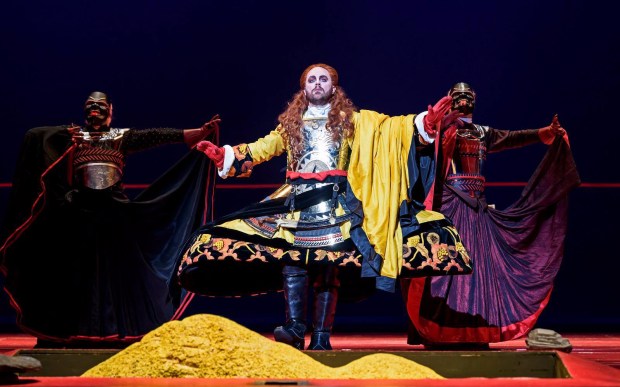
Mitridate Re di Ponto (1770): Wolfgang Amadeus Mozart

michael-spyres-as-mitridate-c2a9-roh-photo-by-bill-cooper.jpg

★★★★

(Royal Opera House, 7 July 2017)

Mitridate, king of Pontus, is missing, presumed dead. His two sons, Farnace and Sifare, have returned from the battlefield to skulk around their father’s palace and engage in the traditional pastime of operatic royalty: viz. each scheming to beat the other to the throne. Farnace, billed as the ‘evil’ son, is considering an alliance with the wicked Romans. Sifare, the ‘good’ son, is deeply in love with his father’s intended bride, the beautiful princess Aspasia. Plots are well underway when – shock horror! – it turns out that Mitridate isn’t actually dead at all, but has allowed such rumours to spread in the hope of testing his sons’ loyalty. When he returns to Pontus, the scene is set for a right royal show-down. One of Mozart’s first operas, written when he was only fourteen, this has its issues – numerous issues – as a piece of work, but it’s presented in the Royal Opera House’s classic and extravagant production, with a really splendid cast.

Continue reading

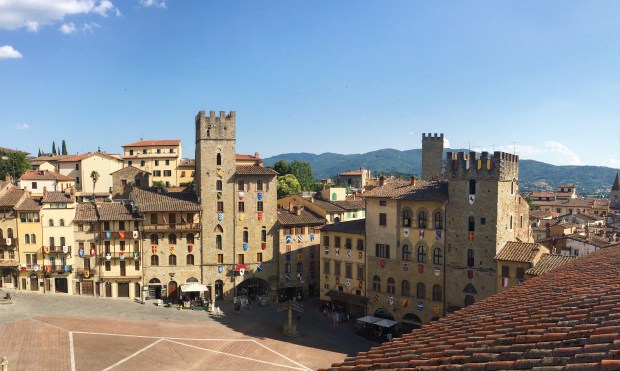
Fraternities and Frescoes: A Week in Arezzo

Arezzo Piazza Grande

Things have been a little quiet at The Idle Woman recently because I was away in Italy last week on the inaugural Arezzo Summer Course. This is aimed at doctoral students, curators and others with a professional or academic interest in prints. It offers the chance to hear from scholars in the field, who present lectures on their current research, as well as including field trips to various collections and print rooms. I imagine the feel will be different every year, depending on the scholars who come to act as ‘professors’, but this year the course was perfectly aligned to my interests. One of its themes was to look at the interaction between music and printmaking – specifically the way that prints were used to record ephemeral festivities, theatrical events and pieces of music like cantatas, which until the late 17th century existed only as part of an oral tradition.

Continue reading

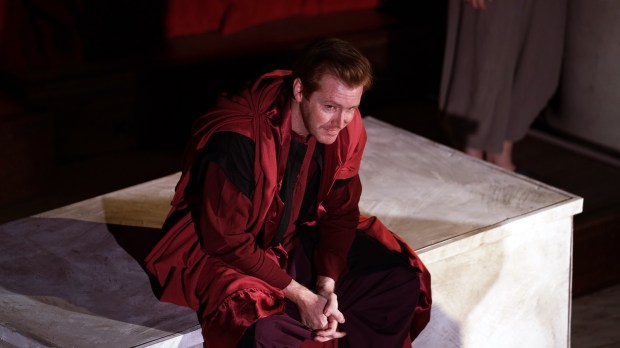
Apollo and Hyacinthus (1767): Wolfgang Amadeus Mozart

Mozart: Apollo et Hyacinthus

(Classical Opera at St John’s Smith Square, 12 June 2017)

When I was eleven, I was obsessed with ponies and still spent an unconscionable amount of time playing with dolls. When Mozart was eleven, he wrote his first opera. Such is life. In this concert, Classical Opera presented three pieces written by the precocious composer between 1766 and 1767, which predictably sounded as rich and sophisticated as many a work by any other mature composer. Staged simply and effectively, with some impressive performances from the crack team of singers, these pieces were the ‘Lambach’ Symphony in G major (K45a), the sombre Grabmusik (K42) and the little opera Apollo et Hyacinthus. As there were three different pieces, I’ve treated this as a recital, which is why I haven’t given it the usual star rating.

Continue reading