The Blood of Flowers (2007): Anita Amirrezvani

★★★

Although this is the second novel I’ve read by Anita Amirrezvani, it was actually her debut, which drew on her rich Iranian heritage to create a story of love and loss set in dazzling 17th-century Isfahan. It’s a tale of overlapping relationships, largely between women: those between mother and daughter; between friends; and between an established woman and her poor relations. But, most of all, it’s a tale of craftsmanship – of carpets: the sumptuous Persian carpets designed by masters in the workshops of Isfahan and knotted with painstaking patience, which are splendid enough to be venerated as works of art in themselves.
Continue reading

Hipermestra (1658): Francesco Cavalli

Cavalli: Hipermestra

★★★★½

(Glyndebourne, conducted by William Christie, 17 May 2017)

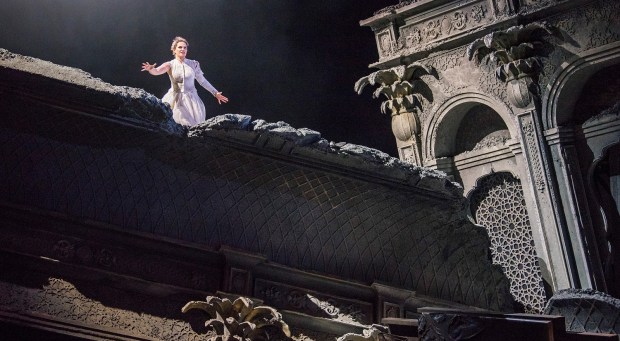
King Danao of Argos is troubled. His brother’s Egyptian troops have gathered on his border, forcing him to suggest a diplomatic match to avoid conflict. His fifty daughters will marry his brother’s fifty sons in a mass ceremony, cementing a peace treaty between the two nations. But Danao has given his daughters secret instructions. The Oracle at Delphi has warned him that one of his nephews will rob him of his life and kingdom. And so each of the fifty girls has been ordered to murder her husband on their wedding night. Each of them obeys. Except one: Hipermestra, who loves her new husband, her cousin Linceo, and urges him to escape. Her compassion will be rewarded by a tide of blood. In this thrilling premiere of an all-but-forgotten opera by Francesco Cavalli, Glyndebourne have updated an ancient story to a setting in the modern Middle East, giving it a punch that lingers long after the final curtain comes down.

Continue reading

The Lunchbox (2013)

The Lunchbox

★★★★

In Mumbai, office workers don’t pop round to their local Pret at lunchtime. Instead, they benefit from the astonishing system of dabbawalas, 4,000 of whom collect and deliver 160,000 packed lunches every day through the bustling city. The lunchboxes are carried by bike and train into the centre of Bombay and delivered promptly to the workers’ desks just in time for the lunch break; then, after lunch, the empty tins are packed away and carried home again. Stay-at-home housewives take pride in sending off a home-cooked lunch for their children or husbands; while even unmarried office workers receive lunchboxes courtesy of services offered by local restaurants. It’s like clockwork. The dabbawalas don’t make mistakes. But this charming little film imagines what might happen if they did – and if that mistake accidentally brought two lonely people together.

Continue reading

My Name is Lucy Barton (2016): Elizabeth Strout

★★★½

This book has been everywhere, the last year or so, and I’m aware that I’m coming to it rather late. I found it a strange novel: sobering, yes, but also frustrating. It flirts with the promise of autobiography; shares selectively; and sometimes overshares when it would have had more impact to leave questions open. I suspect its themes of the bond between mothers and daughters is what has made it such a book group favourite, but the bond it holds out to us is a troubling one: threaded through with incomprehension, abuse, misery, anxiety and – only at the last – the possibility of compassion and comprehension.

Continue reading

The Hangman’s Daughter (2008): Oliver Pötzsch

★★★

The Hangman’s Daughter: Book I

There’s an amusing story about a time, some years ago, when I decided to read The Hangman’s Daughter. It had recently come out and I’d heard good reviews, so I trotted off to the library and borrowed it. I did my best to get into it, but it was rather staid and old-fashioned and I really wasn’t impressed. Then I realised what had happened. I’d taken out The Monk and the Hangman’s Daughter by Ambrose Bierce. Having now, finally, found the right novel, I enjoyed this tale of small-town life and witchcraft in 17th-century Germany, although I’d have liked it even more if it were a bit more streamlined.

Continue reading

Canaletto and the Art of Venice (2017)

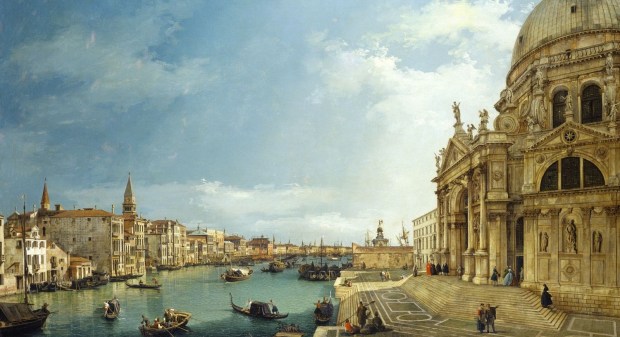
Canaletto: View of the Salute

(Queen’s Gallery, London, until 12 November 2017)

In 1762, the young George III purchased en bloc the collection of Joseph Smith, the British consul in Venice. In doing so, he became at one stroke the owner of the greatest collection of Canaletto paintings and drawings in the world. These works have been in the Royal Collection ever since and now, gloriously, they’re brought together in a stunning exhibition at the Queen’s Gallery, offering an abundance of Venetian delights. All in all, if you have any fondness for Venetian splendour, you must not miss this show.

Continue reading

L’Incoronazione di Poppea (1643): Claudio Monteverdi

Monteverdi: L'Incoronazione di Poppea

★★★½

(Hampstead Garden Opera at Jackson’s Lane Theatre, 12-21 May 2017)

This spring, Hampstead Garden Opera are trying something new: their first Italian opera staged in the original language rather than English translation. The opera in question is Poppea, a perennial favourite of mine. Who could resist this blend of scheming, sexual abandon, murder and imperial arrogance? Certainly not me. Presented on a stripped-back set, this production focuses the attention firmly on the two women, Ottavia and Poppea, competing for the heart of Rome’s indolent, decadent emperor. With sterling support from Musica Poetica, under the baton of Oliver John Ruthven, and a number of exciting voices to add to my watchlist, it was a thoroughly enjoyable afternoon out.

Continue reading

The Buried Giant (2015): Kazuo Ishiguro

★★★½

Gosh, what a strange novel. Part historical fiction, part fable, this book feels wilfully enigmatic, its meaning hovering just beyond reach, like a shattered reflection in water. This is only the second of Ishiguro’s novels that I’ve read (the first, some years ago, was Never Let Me Go) and so I’m not sure which elements are typical of his writing and which merely adopted for this book. One thing which the two books have in common, though, is that an apparently simple story turns out to have a much deeper significance. I have a sneaking suspicion that The Buried Giant has several layers, so this post is primarily an attempt to tease out meaning from this dreamlike tale of an ancient British past.

Continue reading

The Four Seasons (2008): Laurel Corona

★★★½

When two young sisters are abandoned on the doorstep of the Pietà in Venice in 1695, they enter the care of an extraordinary institution: part foundling hospital, part secular convent, and part conservatorio. The girls of the Pietà learn to love God through the medium of music, whether by playing an instrument or by singing in the weekly Masses, which draw admiring crowds to the chapel beyond the grille that prevents any of the performers being seen. And the soloists of the Pietà become stars, their talents as well-known as any opera singer’s, even though they must remain screened away. Of these two abandoned sisters, one, the playful and exuberant Chiaretta, will turn out to have a voice that wins her legions of admirers. The other, Maddalena, looks in vain for an instrument that sparks the inner core of her being. But then she discovers the violin, at around the time that the Pietà hires a young priest to help with giving lessons: a virtuoso violinist and budding composer with flaming red hair, named Antonio Vivaldi.

Continue reading

Half a King (2014): Joe Abercrombie

★★★★

The Shattered Sea: Book I

When I found this book in the library, I decided to spend some quality time with Joe Abercrombie. I’ve meant to read his novels for ages and now, having enjoyed my first taste of alleged ‘grimdark’ thanks to K.J. Parker, and savoured Abercrombie’s short story Two’s Company, I think the time has come. I’d always intended to start with The Blade Itself, but this story caught my imagination right away. A king murdered in strange circumstances. A prince robbed of his throne by a wicked uncle, and sold into slavery. And a ragtag band of galley-slaves stumbling into the wilderness, dreaming of freedom… and revenge. Oh yes. This was definitely my kind of book.

Continue reading