Eagles in the Storm (2017): Ben Kane

★★★★

The Eagles Trilogy: Book III

I’ve been eagerly awaiting this final book in Ben Kane’s Eagles trilogy, which completes a story that I’ve followed avidly in Eagles at War and Hunting the Eagles. The series follows the military and psychological aftermath of the Battle of the Teutoburg Forest in 9 AD, when three Roman legions under the command of Publius Quinctilius Varus were wiped out by a German tribal army under the aegis of the chieftain Arminius, a former Roman ally. In the first book we watched the tragedy unfold; in the second, set some years later, we saw the young general Germanicus stiffening the Romans’ resolve as Arminius tried to knit the tribes together into a viable force. Now, in 15-16 AD, the moment has come for battle to be joined again, and this time there can be only one victor.

Continue reading

The Goddess Chronicle (2008): Natsuo Kirino

★★★½

Back when the Canongate Myths series was introduced in 2005, I bought the first three in a boxed set and swore I’d read all of them as they were published. Needless to say, that didn’t happen. And so, when I realised that Natsuo Kirino (whose Grotesque I admired) had contributed a story to the series, it was a welcome chance to catch up. Retelling the Japanese myth of Izanami and Izanaki, this is an eerie tale of joy and sorrow, light and darkness, love and vengeance.

Continue reading

Edwin: High King of Britain (2014): Edoardo Albert

★★★½

The Northumbrian Thrones: Book I

There’s a bit of a thrill in reading a story whose exact dates are lost in the mists of time. In this first novel of Albert’s series, we are in the early years of the 7th century, perhaps in 616 or thereabouts. The Romans are long gone, leaving their ruins and their roads behind them; the raiders from the east have yet to come over the grey whale-road. Britain is split into kingdoms, roughly following the lines of the old tribal lands from the days of Boudica. But times are changing. A man who has moved from host to host, keeping one step ahead of the king who wants to kill him, has a dream of a united country, its petty kings subject to one overarching High King. It’s a grand dream, for a man who doesn’t even have a single kingdom to his name yet, but Edwin is shrewd and brave and has loyal men. As he inches his way back to power, his own rise is mirrored by that of a new religion, brought over from the Franks: a religion which will change the face of Britain forever.

Continue reading

The Girl in the Glass Tower (2016): Elizabeth Fremantle

★★★★

It is 1615 and the years have not been kind to Aemilia Lanyer. Once, she and her poetry were celebrated at Court but, since the accession of James I, with his dislike of educated women, Aemilia has been forced to live a meaner existence. Now, weighed down with the debts of her dead husband, she ekes out her days in Clerkenwell with her teenage son Hal. It is Hal who offers Aemilia some unexpected distraction from her financial woes. As a young musician at Court, he happens to see the rooms of the late Arbella Stuart being cleared. Remembering that his mother once knew this unfortunate princess, he brings home a bundle of old papers destined for the fire, little realising what a treasure he has found. For this is Arbella’s account of her own life: the tale of a woman who dared to dream beyond the confines in which circumstances kept her. Faced with the words of this almost-friend, a woman she never truly understood, and one whom she inadvertently betrayed, Aemilia longs to finally learn the truth about Arbella Stuart.

Continue reading

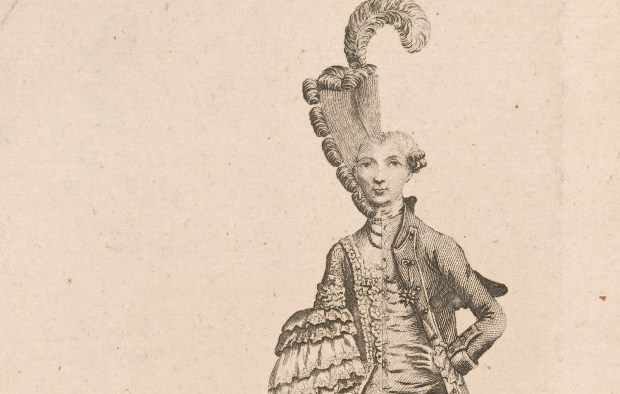
The Swashbuckling Life of the Chevalier d’Eon

The Chevalier d'Eon

I mentioned in my post on Monsieur d’Eon is a Woman that I’d been asked to give a lecture in my professional capacity about the Chevalier d’Eon. I’m pleased to say that it went very well and feedback suggests that the Chevalier’s story exerts just as much fascination today as it did back in the 18th century. Since there’s a lot of misleading information about the Chevalier online, and since this remarkable story deserves to be known more widely, I decided to turn my lecture into a blog post. What follows is, therefore, considerably longer than my usual posts but is amply illustrated. The British Museum has almost sixty prints and other documents relating to the Chevalier’s life in London, many of which I reproduce here. So let’s delve in to a tale of espionage, secrecy, swashbuckling and remarkable self-fashioning.

Continue reading

All Our Wrong Todays (2017): Elan Mastai

★★★★

Elan Mastai’s debut novel is a sharp, mind-scrambling book which asks us to imagine how one person could change the course of history. On 11 July 1965 in San Francisco, the visionary scientist Lionel Gottreider switches on a generator that utilises the force of the earth’s rotation to produce a limitless supply of clean and cheap energy, and transforms the world forever. Fifty years later, in 2016, Tom Barren bumbles his way through the sleek utopia that has been made possible by Gottreider’s brilliance, never imagining that he will be responsible for destroying the world as he knows it.

Continue reading

Britt-Marie Was Here (2014): Frederik Backman

★★★★

In the wake of My Grandmother sends her Regards and Apologises, I was keen to read more of Frederik Backman’s gently ironic stories. Luckily, my library also had Britt-Marie Was Here in stock. This takes place after My Grandmother and so, if you’ve read that, you’ll understand more of the backstory here. However, Britt-Marie also serves very easily as a standalone tale, a life-affirming story of an anxious, touchy middle-aged woman learning that she still has something to offer the world – and herself.

Continue reading

The Last Bell (2017): Johannes Urzidil

★★★★

Johannes Urzidil was one of the most celebrated Czech writers of the 20th century. Although he spent his last twenty years as an emigre in the United States, he never made the switch to writing in English. His works continued to be published in Europe in German (one of his two mother tongues) and his works were infused with the sensibility of his homeland. Despite his importance in European literature, his works have only rarely been translated into English. Pushkin Press have rectified this omission with a collection of Urzidil’s short stories, none of which have formerly been published in English, and translated now by David Burnett. Lively, moving and gently absurd, these stories focus on outsiders, people whose encounters with ordinary life and emotions leave them thwarted and unmasked as precisely the strange creatures that they are.

Continue reading

Westworld: Season 1 (2016)

Westworld

★★★★½

Sometimes you just have to binge-watch a series and I’ve been completely captivated by Westworld, which I discovered on Amazon a couple of weeks ago. For those who haven’t yet come across this phenomenon, it’s a TV series developed from a 1973 film written by Michael Crichton, who seems to have a bit of a thing about immersive theme parks that go wrong (remember his modest little film about dinosaurs?). Westworld presents us with a vast, sprawling park in which visitors can play out their Wild West fantasies of murder, adventure and sexual domination, interacting with an astonishingly advanced group of ‘hosts’, or robots programmed with particular characters and storylines. It’s epic, ambitious and astonishingly well-made, with a fantastic cast. A real must-see.

Continue reading

Carnivalesque (2017): Neil Jordan

★★★

Everyone knows that circuses are magical places, but they can be dangerous too, subversive, circumventing the rules of society, propriety and even reality. One day, young Andy loses himself in the hall of mirrors in a carnival sideshow. When he emerges some hours later, he both is and is not himself: that is to say, his body is unchanged, but the thing inside him is no longer Andy; or, at least, not the boy he was before. That old Andy, or his essence, is trapped within the speckled glass of the mirror-maze, snatched or changed, call it what you will, and ready to be drawn out into the inner life of this fantastical place. Part fable, part fantasy, part horror-story, this novel is rooted in a strong concept but preserves its enigma too fiercely, to the point that the reader never quite comes to engage emotionally with its character or narrative.

Continue reading