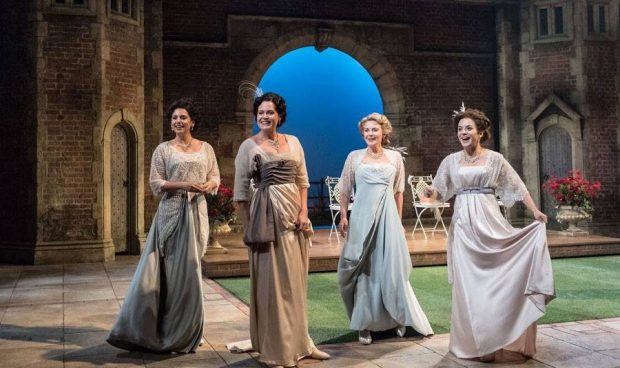
Love’s Labour’s Lost (1597): William Shakespeare

Shakespeare: Love's Labour's Lost

★★★★½

(Royal Shakespeare Company, Haymarket Theatre, until 18 March 2017)

There are days when the whole world seems pitched against you. On Monday there was a Tube strike, it was pouring with rain and, too late, I found a hole in my boot. On arriving at the Haymarket, cold and grumpy and with a very wet sock, I was not disposed to be happy. But the RSC’s latest London transfer could charm a smile out of a stone. Two plays have come to town: Love’s Labour’s Lost and Much Ado About Nothing. Conceived as two halves of a pair, joined by a common spirit if not by the same characters, these plays unfold in a country house on either side of the First World War. Brimming with light and life, skirmishing lovers and rapier wit, they’re bubblier than a bottle of prosecco.

Continue reading

Wyrd Sisters (1988): Terry Pratchett

★★★★

The Discworld Reread: Book VI

All Magrat Garlick ever wanted was to be part of a proper coven. She’s new to witchcraft and takes it all very seriously, from the garlands of flowers to the moon-worship and the amulets, and it would have been nice to have fellow witches who appreciated the value of a proper sabbat. But instead she has steely Granny Weatherwax, who can’t be having with all this modern nonsense, and riotous Nanny Ogg, who’s usually to be found singing that classic Discworld drinking song, The Hedgehog Can Never Be Buggered At All. And Magrat has to prove to them that she’s a proper witch! And that isn’t all, because there is something dark afoot, something that the three of them must tackle. Something is rotten in the state of Lancre, and the witches may be the only ones who can save the day…

Continue reading

In Calabria (2017): Peter S. Beagle

★★★½

This charming little fable is a tale of what can happen when the miraculous imposes on the ordinary. It tells the story of the cantankerous Calabrian farmer Claudio Bianchi, who lives alone on a remote farm with his half-wild cats, his dog Garibaldi, his cows and his goat Cherubino. He shuns company and can go weeks at a time without seeing anyone but the cheery young postman Romano. All he wants is peace and quiet, to till his earth and write his poetry. But then, one day, he sees a unicorn in his vineyard.

Continue reading

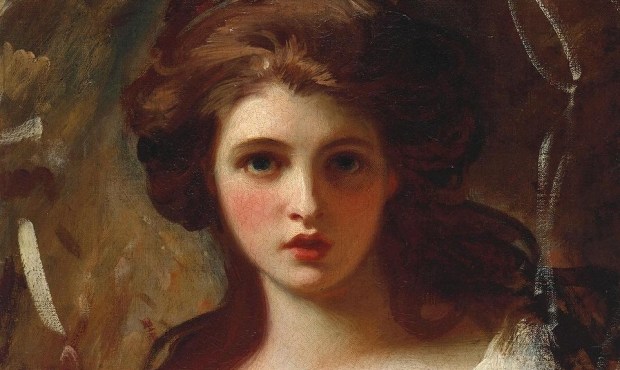
Emma Hamilton: Seduction & Celebrity (2016-17)

Romney: Emma as Circle

(National Maritime Museum, Greenwich, until 17 April 2017)

If you aspired to be anyone in the 1790s, one of the mandatory stops on your Grand Tour would be the villa of Sir William Hamilton, British envoy in Naples. You would enjoy Hamilton’s learned conversation, admire his remarkable collection of antiquities and, perhaps, take a trip up Vesuvius to admire the steaming crater. And, if you were especially fortunate, you might have the chance to see Lady Hamilton perform her famous Attitudes, a series of tableaux vivants representing famous women from the Classical world. Yet the appeal was as much due to Lady Hamilton’s notoriety as her talents.

Continue reading

The Many Selves of Katherine North (2016): Emma Geen

★★★★

The village where I grew up is tiny even by the usual standards of English country villages: thirty houses; a hundred residents; no shop; no pub. And yet it’s had its fair share of literary energy. Legend has it that Wilkie Collins started writing The Moonstone at the Manor House; Dick King-Smith used to live down the other lane; and now, to my surprise and delight, I see that one of my former neighbours has also published a novel. I wouldn’t say that I ever knew Emma Geen (it feels weird to refer to her solely by surname as I usually do with authors), but I still approached this book with a mixture of excitement and trepidation. And it was all rewarded. Without a shadow of partiality, I can say that this is an assured and accomplished debut: tight, edgy and thoroughly gripping; a sophisticated blend of thriller and troublingly plausible sci-fi.

Continue reading

Sourcery (1988): Terry Pratchett

★★½

The Discworld Reread: Book V

Sourcery was never one of my favourite Discworld novels but, on rereading it, I was struck even more strongly by the sense that it’s a step backwards. Mort pioneered the formula that would make the series so successful: a close focus, a concept borrowed or inspired by those of our own world (for me, Mort has always been akin to The Sorcerer’s Apprentice) and limited, wise deployment of fantasy tropes. Sourcery, by contrast, feels more like The Light Fantastic, linked not only by the presence of Rincewind and the Luggage, but also by barbarians, a wide-ranging quest, magical wars, ambitious wizards and, of course, the End of the World being Nigh once again.

Continue reading

The Raven and the Reindeer (2016): T. Kingfisher

★★★★

As 2017 simply hunkers down in the bitter cold of winter, I find myself drawn to fairy tales and fantasies: the kind of stories you could tell beside a fire with the storm raging outside. This novella was my first encounter with T. Kingfisher (the pseudonym of Ursula Vernon), an author whose books have often been recommended to me by Goodreads. It’s a retelling of The Snow Queen, which I’ve read many times in my much-loved childhood copy of Hans Christian Andersen’s fairy tales. Smart and knowing, The Raven and the Reindeer delivers up all the magic without any of the piety, a marked glint in its eye.

Continue reading

The Wolf in the Attic (2016): Paul Kearney

★★★★

This was an extraordinary read: a real shapeshifter of a book. It began like a children’s story, full of the innocent fancies of an isolated little girl, but then morphed into an eerie fantasy full of symbolism and old magic. The most frustrating thing about the whole novel is that its final pages introduce a whole new potential canvas and then, with so many questions unanswered, and so much backstory unexplained, it simply finishes. I assumed that it must surely be the first part of a series but, so far, I haven’t found any mention of a planned sequel. And so I’ve been left feeling strangely short-changed because, for the most part, this is a genuinely gripping world and so much more could have been said.

Continue reading

The House at Bishopsgate (2017): Katie Hickman

★★★★

The Pindar Trilogy: Book III

I only realised that this novel was the third part of a trilogy after I had finished it, which goes to show that it reads perfectly well as a standalone book. In fact, I’m delighted to discover this because The House at Bishopsgate has left me itching to know more about the characters’ exotic histories. This is the concluding part of a story begun in The Aviary Gate and continued in The Pindar Diamond, neither of which I’ve yet read, but watch this space, as they might make an appearance soon. Hickman’s tale of intrigue, secrets, lost love and scheming ambition makes for an addictive brew.

Continue reading

Arsenic for Tea (2015): Robin Stevens

★★★★

A Murder Most Unladylike Mystery: Book II

First off, a Happy New Year to one and all! I hope that 2017 brings you lots of exciting discoveries, wonderful stories and engaging discussions. For my own part, I kicked off the year with a self-indulgent treat: the second book in Robin Stevens’s schoolgirl detective series. You may remember that I was utterly charmed by Murder Most Unladylike and I was itching to see what Daisy and Hazel’s next case would be. It turns out that the sequel is no less delightful.

Continue reading