An Accidental King (2013): Mark Patton

★★

In 79 AD, an old man looks back over his life and prepares to write his memoirs for his granddaughter. He is Tiberius Claudius Cogidubnus, born and bred in the British southlands of the Regenses. Trained as a priest, he was then crowned an unwilling king, first of his own tribe and then as Great King of all the Britons, with the weight of the emperor’s authority behind him. As he remembers his experiences across three decades – from a visit to Rome with the then-general Vespasian, to the horror and fire of Boudica’s revolt – Cogidubnus meditates on the tightrope he has had to walk throughout his life: defending his people, while remaining loyal to a vast and unpredictable foreign power.

Continue reading

The Liars’ Gospel (2012): Naomi Alderman

★★★★

As a writer, Naomi Alderman is a veritable chameleon. First I read The Lessons, a tale of a fall from grace among the dreaming spires, in the manner of a modern Brideshead. Then it was The Power, a Margaret-Atwoodesque novel that veered between dystopia and sci-fi: a feminist, egalitarian cry of rage. And now, the third of her novels that I’ve read, The Liars’ Gospel is a raw and rugged historical novel. Brave, too, because it dares to confront one of the world’s seminal figures: in life, a controversial and provocative young preacher in 1st-century AD Judea; and, in death, the begetter of a cult that would become one of the dominant religions of the world. But who exactly was this teacher?

Continue reading

Boudica: Dreaming the Hound (2005): Manda Scott

★★★★

Boudica: Book III

And so to the third instalment of Manda Scott’s Boudica quartet, which I’m eking out so as not to finish it too soon. Dreaming the Hound takes us deeper into the story of Breaca, the flame-haired warrior whose leadership against the invading legions has earned her the title of the Boudica, ‘bringer of victory’. It also follows the life that runs parallel to her own: that of her conflicted, troubled half-brother, once named Bán, and then Valerius, who served as decurion of the Thracian cavalry under the aegis of Rome and is now, unwillingly, back among his own people.

Continue reading

Hunting the Eagles (2016): Ben Kane

★★★★

The Eagles Trilogy: Book II

Five years after the massacre in the Teutoburg Forest, we rejoin the Roman centurion Tullus, his optio Fenestela and his loyal men Piso and Vitellius as they work to come to terms with the loss of their legion and their eagle. Their presence at the catastrophe has hit them hard. Officially forbidden to set foot in Rome, they remain on the German frontier, allocated to new legions, demoted (in Tullus’ case) and subject to the stares and mockery of men who weren’t there to witness what they saw.

Continue reading

Eagles at War (2015): Ben Kane

★★★★

The Eagles Trilogy: Book I

In a sacred grove in the depths of a German forest, a seven-year-old boy watches a human sacrifice and takes an oath which will shape his entire life and strike at the very heart of Roman power. The boy’s name is Ermin of the Cherusci. He will grow up to become Arminius, Rome’s ally, Rome’s auxiliary and Rome’s greatest enemy.

Continue reading

Boudica: Dreaming the Bull (2004): Manda Scott

★★★★

Boudica: Book II

Naturally it didn’t take long for me to plunge into the second of Manda Scott’s Boudica books after my admiration for the first volume, Dreaming the Eagle. It is just as magisterial and sensitive as its predecessor, with an epic sweep that now opens out far beyond the tribes of Britannia. Rome is, both culturally and geographically, a more significant player here. Perhaps it lacks a little of the tightly-forged focus of that first book, but this is often the case with second instalments, which both open and close mid-action, as it were. But if that’s a flaw, it’s small and scarcely visible in the finely-crafted whole. Weaving between her two protagonists with elegance, and a fine feeling for the grey areas of the soul, Scott creates yet another gripping glimpse of a lost history.

Continue reading

Boudica: Dreaming the Eagle (2002): Manda Scott

★★★★★

Boudica: Book I

Three years ago, just after finishing the last novel in Dorothy Dunnett’s Niccolò series, I asked for recommendations of similar books to fill the gap. Although Manda Scott’s Boudica novels were mentioned several times, I didn’t follow them up. I think I shamefully leapt to the conclusion, without any evidence whatsoever, that Boudica was just another identikit sword-and-shield historical series. How wrong I was. When I recently found the first book in a second-hand sale, I decided to see what I made of it. And it’s stunning.

Continue reading

Island of Ghosts (1992): Gillian Bradshaw

★★★★

Hot on the heels of The Beacon at Alexandria, I turned my attention to the other Bradshaw novel I had lined up, and I’m delighted to say that Island of Ghosts proved to be equally enjoyable. Like Beacon it has a classical setting, this time in Roman Britain in 175 AD, and it’s written in the same easy, engaging style. Indeed, its protagonist is thoughtful and self-contained, much like Charis, and there are familiar themes of displacement and the difficulties of finding one’s path as an outsider.

Continue reading

Master and God (2012): Lindsey Davis

★★★★

An Epic of Rome, Tyranny and Love

I discovered this novel tucked away near the back of our little lending-library shelf at work. I’m not all that familiar with Lindsey Davis’s Falco books, but I’ve read the one where he goes to Alexandria and remembered enjoying it, so I decided to give this standalone novel a try. Like the Falco series it’s set in ancient Rome, this time roughly covering the period of the emperor Domitian, from 80-96 AD. However it isn’t a mystery and, as far as I know, the characters are entirely different from those in Falco. From the very first line (‘It was a quiet afternoon on the Via Flaminia‘) I was drawn into Davis’s world, and can honestly say that this has been one of the most heartwarming, lovable books I’ve read in a long time.

Continue reading

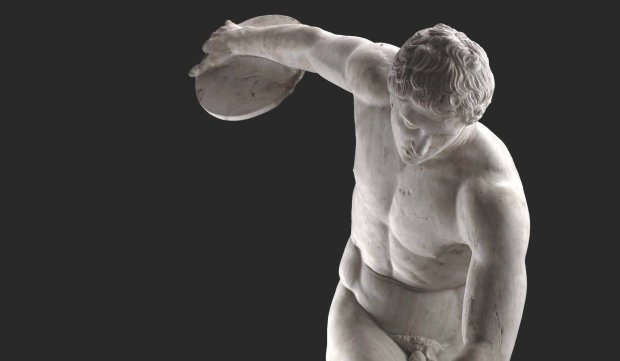
Defining Beauty: The Greek Body (2015)

Defining Beauty: Discobolos

(British Museum, London, until 5 July 2015)

I’ve been terribly lax at writing about exhibitions recently, and this post is actually far too late because the show has just closed. Nevertheless there were such beautiful things on display that I still wanted to write a little about it; and I hope some of you had the chance to see it. The theme was, very simply, the body in Greek art; but it went beyond the predictable athletic male nude, which for the Greeks, and for so many cultures since, has been the pinnacle of physical perfection. The show also looked at sculptures of the female body, whether divine or mortal; at representations of the body throughout the life cycle; and at sculpture on different scales and in different modes, from heroic to comic.

Continue reading