The Winter Isles (2015): Antonia Senior

★★★★

Lyrical and heartfelt, this novel set in 12th-century Scotland feels like a natural successor to King Hereafter. It occupies much the same territory, following the ambitious young lord Somerled as he negotiates the rivalries and alliances of the Western Isles and develops a name for himself as a fearless warrior. Based on a figure who is as tantalising a blend of history and myth as Macbeth himself, it’s a novel that lingers on the feel of the wild land and the yawning breadth of the playful, fearsome, lovely sea, despite the occasional savagery of its battle scenes. With characters you truly grow to care about, and with a wonderful star-crossed love story at its heart, it’s a rewarding read.

Continue reading

Oswiu: King of Kings (2016): Edoardo Albert

★★★★

The Northumbrian Thrones: Book III

In this third and (currently) last instalment in The Northumbrian Thrones, the ramifications of Oswald‘s untimely death spread across the feuding kingdoms of Britain. It is now 642 AD and the unification that seemed within reach during the reign of Edwin has crumbled away. Even Northumbria is no longer united. Oswald’s younger brother Oswiu faces a long, hard battle to secure his kingship against the mightiest ruler in the land: Penda, ambitious and ruthless king of Merica. But Oswiu has one advantage that Penda lacks: the posthumous, miracle-working reputation of the murdered Oswald.

Continue reading

Oswald: Return of the King (2015): Edoardo Albert

★★★★

The Northumbrian Thrones: Book II

Having warmed to Albert’s Edwin in its second half, I was keen to follow the struggle for Northumbria into its next generation. Oswald opens in 633, with High King Edwin’s death in battle against Penda of Mercia, and Cadwallon of Gwynned. His fall throws his kingdom’s future into the balance as predators circle the vacant throne. Cadwallon would have Northumbria as a client kingdom, but there are still men living who have the right to rule as independent kings. These come from two rival families: the Yffings (descendants of Edwin) and the Idings (descendants of Edwin’s predecessor, Aethelfrith). And whoever becomes king must now face up to this new power that has grown, unchecked, in the west. Northumbria desperately needs a worthy leader, but the one who can best answer that call is, ironically, the one claimant who wants nothing less than to be a king.

Continue reading

Edwin: High King of Britain (2014): Edoardo Albert

★★★½

The Northumbrian Thrones: Book I

There’s a bit of a thrill in reading a story whose exact dates are lost in the mists of time. In this first novel of Albert’s series, we are in the early years of the 7th century, perhaps in 616 or thereabouts. The Romans are long gone, leaving their ruins and their roads behind them; the raiders from the east have yet to come over the grey whale-road. Britain is split into kingdoms, roughly following the lines of the old tribal lands from the days of Boudica. But times are changing. A man who has moved from host to host, keeping one step ahead of the king who wants to kill him, has a dream of a united country, its petty kings subject to one overarching High King. It’s a grand dream, for a man who doesn’t even have a single kingdom to his name yet, but Edwin is shrewd and brave and has loyal men. As he inches his way back to power, his own rise is mirrored by that of a new religion, brought over from the Franks: a religion which will change the face of Britain forever.

Continue reading

Blood Feud (1976): Rosemary Sutcliff

★★★★

After starting my Sutcliff journey with Sword at Sunset, I always intended to read The Eagle of the Ninth next, but things didn’t quite happen as planned. I have a lot of great big thick books lying around at the moment and, while hunting for something short as a kind of palate-cleanser between epics, I unearthed this little novel. It was allegedly written for children but, in the tradition of the best children’s literature, it’s equally rewarding to read as a grown-up. In fewer than two hundred pages, Sutcliff spins a stirring tale of honour, bravery and adventure, the Viking sea road and the golden domes of Byzantium. How could I resist?

Continue reading

Meadowland (2005): Thomas Holt

★★★

John Stetathus doesn’t want to go to Sicily. As a fretful middle-aged accountant in the Byzantine civil service in 1036, the last thing he wants to do is to leave his comfy life in Constantinople, and traipse off overland to supervise the delivery of the pay packet to the Emperor’s troops. But he has ‘a knack for languages and a fatal tendency to listen to people‘, so his fate is sealed. And what makes it even worse is that there isn’t any decent company on the way. All he has are three Varangian guards: great brutish Northerners who don’t offer the slightest hope of civilised conversation. But travel wears a man down and so, one night (having a knack for languages), he begins in desperation to talk to them.

Continue reading

The Lords of the North (2006): Bernard Cornwell

★★★½

The Saxon Stories: Book III

Oh Uhtred. How I’ve missed you. Although it’s now been almost a month since I read this, I can still remember how refreshing I found it. That was during my deadline period where I was desperate for non-work-related reading material but entirely lacked the energy or mental capacity to write any blog posts; so I apologise. As you might remember, I’ve already read the first two novels in Bernard Cornwell’s series about Alfred the Great and the third proved to be just the tonic for some undemanding escapism. There are times, of course, when I want complex characterisation and meaty, intricate plots; and then there are times (largely coinciding with deadlines) when quite frankly I relish reading about someone like Uhtred, whose manifesto is short, simple and to the point: ‘That is my land. That is my woman. I will kill you now.’ Excellent.

Continue reading

Vikings: Season 2 (2014)

Vikings

★★★★

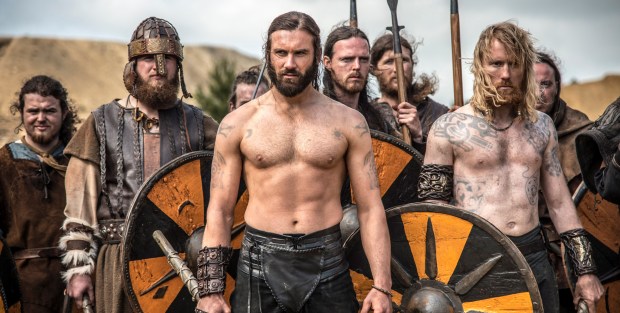
You’ve got to give it to the team behind The Vikings. I thought Season 1 was good; but they kicked off the first episode of Season 2 with an intense battle scene, complete with shield walls, impalement and Rollo surging around without his shirt on; and things simply haven’t let up since. If the first season was about dreams, exploration and quiet calculation, this second season plunges us into the difficulties of keeping hold of power: the negotiation, the double-bluffing and the hard choices about who to trust and who to destroy. Sometimes, as both Ragnar Lothbrok and his enemies will discover in different ways, the most dangerous of men are not those who drink and argue and go fiercely into battle, but those who wait on the sidelines, and watch, and weigh, and measure.

Continue reading

Vikings: Life and Legend (2014)

Vikings: Life and Legend

(British Museum, London, until 22 June 2014)

Bearing in mind I went to see the British Museum’s Vikings exhibition on the day after it opened, almost a month ago, you might think it strange that I haven’t got round to writing about it yet. The simple truth is that it’s been hard to weigh up my thoughts about it. And I’m not the only one who has mixed feelings. The lovely Elisa, a fellow Dunnetteer, came along with me and I think was similarly nonplussed; and I’ve spoken to several other people who’ve shared our feelings. In my particular case, I think I’d probably gone into the show with unrealistically high expectations.

Continue reading

The Sea Road (2000): Margaret Elphinstone

★★★★½

I haven’t read any of Margaret Elphinstone’s books before, but came across this novel shortly after finishing Nancy Marie Brown’s The Far Traveler. That book examined archaeological and literary sources about the life of Gudrid Thorbjarnardóttir, one of the most widely-travelled and adventurous women in the years around 1000. It’s no surprise that I leapt at the chance to see what a novelist could do with the same material; and Elphinstone’s book has proven to be a remarkable thing.

Continue reading