New Pompeii (2016): Daniel Godfrey

★★★

New Pompeii: Book I

Any book which begins with a murder attempt at the British Museum is bound to catch my attention. Nick Houghton, a specialist in Roman history who’s struggling to find tenure at a university, is unwillingly caught up in the chaos. With one of his friends deeply implicated in the plot, he expects to be arrested; but instead the unthinkable happens. He is offered a job by the CEO of NovusPart, one of the most powerful and controversial companies in existence. For NovusPart has developed a technology that can cheat history, plucking people out of the ‘timeline’ and transporting them forward in time, saving them from plane crashes, death or disaster. And they’ve decided that Nick is just the person to help them out with their most recent and most ambitious project: the wholesale relocation of the population of Pompeii (in 79 AD) to the present day.

Continue reading

The Voyage of the Short Serpent (2004): Bernard du Boucheron

★★½

Literary prizes are strange things. This novel won the Grand Prix du roman de l’Académie française in 2004, which led me to expect something rather brilliant, but it fell gloomily short of expectations. Austere, cold and brutal, it tells the story of the medieval Catholic priest Insulomontanus, who is dispatched to New Thule (Greenland) to minister to the faithful. The New York Times regarded the book (translated by Hester Velmans) as a tour-de-force of black humour, but I found it an increasing slog of horrific cruelty and almost unbearable suffering. Framed as Insulomontanus’s grovelling report back to his master, it plays deftly with notions of the unreliable narrator – but that in itself isn’t enough to transform this monotonously miserable story into an engaging read.

Continue reading

Tales of Strange Encounters from Tor.com

Tor.com

Time for another collection of short-stories from the reliably thought-provoking archives of Tor.com. This time I’ve selected a group of tales which focus on strange encounters, in which curious creatures add meaning to characters’ mundane lives, or people unearth odd threads in their own family histories. The stories also have a refreshing cultural and historical sweep, stretching from the modern-day anonymity of a big American city, to the parched grasslands of a post-apocalyptic future; to the exotic charm of medieval China and India at the turn of the 20th century.

Continue reading

The Book of Strange New Things (2014): Michel Faber

★★★★

Peter Leigh believes in miracles. He has escaped a past of alcoholism and addiction, and rebuilt his life with his beloved wife Bea at his side. As a pastor, he hopes to inspire others with the love of God that eventually gave him the strength to break out of his own spiral of destruction. And yet even he is amazed by the marvellous thing that has just happened to him. The vast corporation USIC has selected him, from the hundreds they interviewed, to travel out to the newly-settled world of Oasis, where he will minister to the indigenous population. It’s the greatest missionary opportunity since the days of the early Church. Peter can’t wait to get started. And yet there is one bitterly sad thing about his new adventure. He will have to leave his darling Bea behind.

Continue reading

La Belle Sauvage (2017): Philip Pullman

★★★★

The Book of Dust: Book I

This review is overdue because I read this book back in January, but the delay doesn’t point to anything rather than my own inefficiency. I’d asked for it for Christmas, eager to return to the otherworldly Oxford that I knew so well from His Dark Materials. After so many years, I did wonder whether Pullman would be able to carry off the same magical mixture that he achieved in the original: part children’s story, part moral fable, part religious allegory, which by the end had a truly epic sweep. I hoped I wouldn’t be disappointed. And I wasn’t. For me, La Belle Sauvage didn’t quite have the same wild, transporting alchemy as Northern Lights, but Pullman’s writing remains entirely reliable. To read it is to give yourself up into the hands of a master storyteller.

Continue reading

The Last Romeo (2018): Justin Myers

★★★

Some people say that most first novels are thinly-described autobiography. In this particular case, the disguise is as robust as the Emperor’s New Clothes. Justin Myers, author of the popular Guyliner blog, is probably best known for his ruthless takedowns of the Guardian’s weekly Blind Date column (an occasional guilty pleasure on a Friday afternoon). But he started out as a cataloguer of the gay dating wilderness: a mission shared by the protagonist of his first novel. Blending acerbity with vulnerability, this is a rom-com for the online dating generation, told with panache in Meyer’s distinctive voice, but it rarely convinces as a novel rather than a memoir with names changed.

Continue reading

Hereward (2011): James Wilde

★★★

Hereward: Book I

It’s been a while since I spent some quality time with a murderous early medieval Englishman. Unfortunately I don’t have any more Uhtred books lying around just at the moment, so I’ve had to transfer my allegiance to an equally bloodthirsty kinsman of his: Hereward. In this first volume of a series, James Wilde tells the story of the legendary Saxon warrior who became the figurehead of rebellions against the Normans after the Battle of Hastings in 1066. It’s pretty sound sword-and-shield stuff, with bloody battles, an odd-couple pairing at its heart and a maverick hero. It doesn’t ever transcend that, but it’s an engaging way to encounter this rather dark period of English history.

Continue reading

Songs for Nancy: A concert to celebrate Nancy Storace

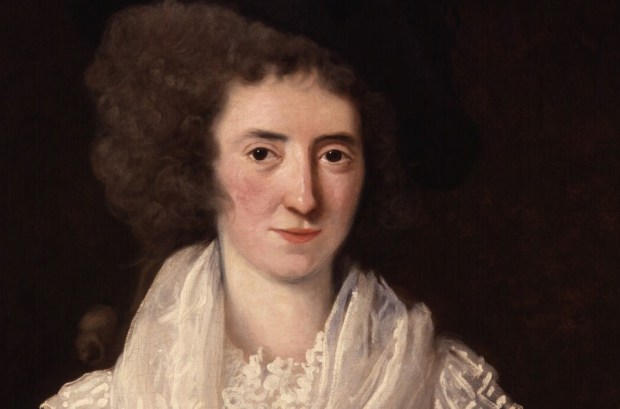
Anna Selina ('Nancy') Storace

(Bampton Classical Opera with Chroma at St John’s Smith Square, 7 March 2018)

This portrait isn’t immediately arresting, it’s true. The sitter, for all her charm, is no great beauty and she’s dressed with tasteful understatement. Her chief attraction is that pair of searching, intelligent black eyes. But, if you’d lived in the late 18th century, you’d have instantly recognised her as one of the most popular singers of the age. She made her debut at the age of seven and became the toast of opera houses throughout Italy, before being invited to Vienna by the Emperor himself. Here she became a favourite of Mozart and Salieri, both of whom composed music for her. She created the role of the Countess in Salieri’s School of Jealousy and was Mozart’s first Susanna in Figaro. And, amazingly, she was a Londoner: born and bred in Marylebone. On the eve of International Women’s Day, Bampton Classical Opera turned the spotlight firmly onto Anna Selina Storace (1765-1817), known as ‘Nancy’, focusing on music written especially for her.

Continue reading

Giasone (1649): Francesco Cavalli

Cavalli: Giasone

★★★½

(Opéra Royal de Versailles, 9 March 2018)

The dauntless Argonauts came to the shores of Colchis in search of the Golden Fleece, but their heroism has been put on hold. For the last year they’ve been kept kicking their heels while their leader, Jason, diverts himself with a mysterious woman. He might be thoroughly enjoying himself but, as his fellow Argonaut Hercules tells him, it’s time to move on. But Jason’s romantic adventures prove harder to shake off than he anticipates, when it transpires that his secret lover is none other than Medea, Queen of Colchis. To make matters worse, his fiancee Hypsipyle, Queen of Lemnos, has grown tired of waiting for him and is coming to fetch him home. Did I mention that Jason has also given each woman twin sons? Amidst the glitz and glitter of Versailles’s Opéra Royal, everything was about to hit the fan in a very, very Baroque fashion.

Continue reading

Imperium (2006): Robert Harris

★★★★½

Cicero: Book I

This book has roosted patiently on my shelf for some time and I’m not quite sure why it’s taken me so long to get round to it. Perhaps I just couldn’t stomach yet another version of the fall of the Roman republic? Or perhaps, shamefully, I felt that a novel about the life of Marcus Tullius Cicero would be rather dry? I was wrong, of course. I was utterly, completely wrong and am glad to be so. Harris’s novel has all the drama of a modern political thriller, underpinned by conscientious faithfulness to place, time and character. It’s superbly paced. Seen through the eyes of Cicero’s devoted secretary Tiro, this is the story of a brilliant man, a tireless, probing and ruthless lawyer, whose desire for rank brings him into the orbit of the most powerful – and infamous – men in Rome. It is a mixed blessing. With the help of such men, Cicero can rise to the heights he has always dreamed about. But at what cost?

Continue reading