The Swerve (2011): Stephen Greenblatt

★★★

How the Renaissance began

The winner of the 2012 Pulitzer Prize for Non-Fiction, this book was recommended to me during our Sicily trip a year ago, in the course of a rather splendid dinner-table conversation. It tells the story of Poggio Bracciolini, an Italian humanist who worked at the papal curia and who, during the upheavals after the Council of Constance, sought to distract himself by going book-hunting in the monasteries of Germany. Poggio dreamed of finding previously unknown classical texts in these monasteries, preserved by chance through years of copying as part of the monastic discipline. He and his fellow humanists had already uncovered fragments of letters and treatises, but the discovery that Poggio would make in 1417 would come to have a powerful impact on the very roots of Western philosophy: the full text of De rerum natura (On the Nature of Things) by Lucretius.

Continue reading

Blood & Beauty (2013): Sarah Dunant

★★★★½

In 1492 the Spaniard Rodrigo Borgia is elevated to the papacy as Pope Alexander VI. It’s an appointment based less on piety than political shrewdness. Generous to his friends and flexible in his scruples, Alexander may not be the pope that Rome wants, but he is the one that it deserves. After all, Renaissance Rome is a seething, ambitious, dangerous city where life is merely a poor shadow of its ancient vanished grandeur. There are as many courtesans as clerics; anything can be had at the right price; and a man can be made to disappear between dusk of one day and dawn of the next. If the Tiber keeps its secrets, he might never be seen again.

Continue reading

Temptations to Devotion (2013)

Attributed to Ligozzi: The Body of Christ

Creating the Italian Altarpiece in the Renaissance and Baroque

(Christ Church Picture Gallery, Oxford, until 14 October 2013)

Since I was in Oxford to see the Ashmolean exhibition, I took the opportunity to pop in to see the current display at Christ Church Picture Gallery. I’m very fond of the gallery because, despite their limited resources, they make a real effort to keep the College’s drawings accessible through a frequently changing programme of displays. The collection isn’t digitised (which is something it would be great to change, if any Oxford students are looking for a bit of volunteering for their CV?), and James Byam Shaw’s famous catalogue doesn’t illustrate all the sheets, so these displays are the only practical way to see the lesser-known drawings.

Continue reading

Fantasy and Invention (2013)

Vasari: Lorenzo de' Medici

Rosso Fiorentino and Sixteenth-Century Florentine Drawing

(The Morgan Library, New York, until 3 February 2013)

Current service has been temporarily interrupted by a business trip to New York, but even there I did my best to keep up the ‘idle’ spirit. On the afternoon of my arrival, I hotfooted it down Madison Avenue to the Morgan, hoping to keep the jetlag at bay by looking at some wonderful drawings. This January’s crop of exhibitions in New York aren’t as focused on the Old Masters as they were last year, and so the show at the Morgan was the one that bore the brunt of my expectations. I was a little disappointed to find that it took up only one room and there was no catalogue; but, nevertheless, that one room contained some beautiful things, many of which I hadn’t seen before. The purpose of the exhibition was to trace the development of Florentine drawing as it grew out of the Renaissance tradition into the full, eccentric bloom of Mannerism.

Continue reading

Late Raphael (2012-13)

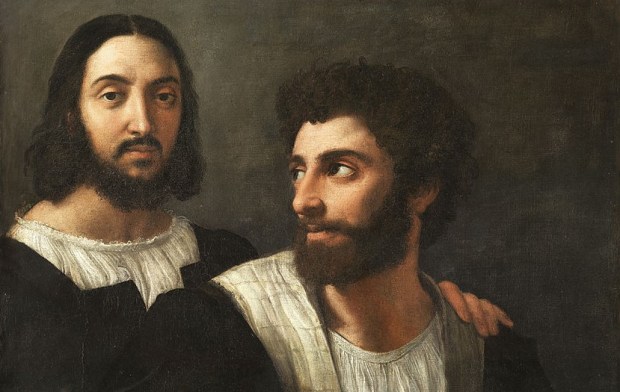
Raphael: Self Portrait with a friend

(Musée du Louvre, Paris, until 14 January 2013)

The things I do for art! Yesterday I got up horrendously early and went to Paris for the day, to visit the Louvre’s Late Raphael exhibition before it closed (yes, I took the Eurostar from London, went to the Louvre, saw the exhibition and took the train right back home again: there’s something faintly surreal about it). Previously at the Prado, this is the natural successor of the National Gallery’s 2004-5 show Raphael: From Urbino to Rome.

Continue reading

The Northern Renaissance: Dürer to Holbein (2012-13)

Holbein: William Reskimer

(Queen’s Gallery, Buckingham Palace, until 14 April 2013)

Back in 2008, the Queen’s Gallery put on the splendid exhibition The Art of Italy, in which the Royal Collection showed off its wealth of Renaissance and Baroque Italian paintings and drawings, assembled over four hundred years by an Italophile monarchy. It was the first exhibition I saw at the Gallery and I remember being amazed by the richness of the Collection’s holdings. The Northern Renaissance is the natural successor to that 2008 show and, while it includes some glorious objects, it is of necessity a more modest exhibition than its predecessor. It comprises 110 exhibits (compared to The Art of Italy‘s 153), of which 22 are prints rather than unique works and seven are arguably Italian rather than Northern.

Continue reading

Gioconda (2011): Lucille Turner

★★★

This was another purchase from Amazon’s Kindle sale. Initially I hesitated over buying it because Leonardo da Vinci is a subject particularly close to my heart. As a teenager, I read a lot about him (I still have at least sixteen books on my shelves) and I have yet to find any novel which gets him entirely right. Yet I keep looking, in the hope that one day I’ll stumble upon a book which does for him what The Agony and the Ecstasy did for Michelangelo. Sadly, this is not that book; although it certainly has its strengths.

Continue reading

A Gift for the Magus (2012): Linda Proud

★★★½

You may remember that a few months ago I spoke of my admiration for Linda Proud’s wonderful Botticelli Trilogy, which follows the circle of painters and philosophers who gathered around Lorenzo de’ Medici in Florence in the 1480s and 1490s. Her newly-published book, which can also be read as a standalone novel in its own right, forms a prequel to that trilogy. Looking back to the foundations of the intellectual and artistic world described in the Botticelli Trilogy, it moves between Florence and Prato over a span of some thirty years, from 1434-1469.

Continue reading

The Noble Art of the Sword: Fashion and Fencing in Renaissance Europe (2012)

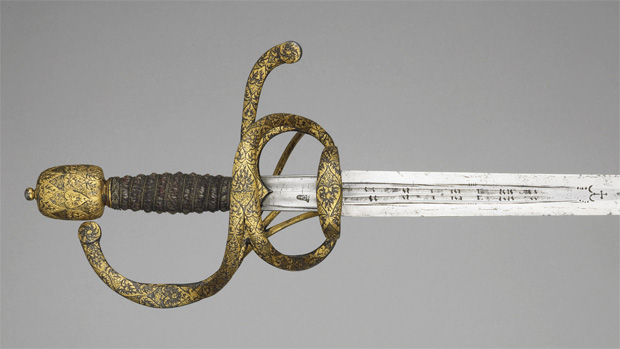
Combined rapier and wheel-lock pistol

(Wallace Collection, London, until 16 September 2012)

Precisely focused both in historical period and subject, this exhibition gives a glimpse of the social culture of swordsmanship that existed in Europe between about 1550 and 1610. It traces the development of the rapier from the broader, shorter swords of the early Renaissance and late medieval period. This wasn’t just a stylistic development: it heralded a completely different approach to the handling of the sword.

Continue reading

Leonardo da Vinci: Anatomist (2012)

Leonardo: Study of a skull

(The Queen’s Gallery, London, until 7 October 2012)

We’ve been well and truly spoiled for Leonardo this year and it’s only six months in.  There has been the blockbuster exhibition at the National Gallery, the exhibition in Turin at the same time, the Louvre’s show based around The Virgin and Child with St Anne, the touring exhibition of Leonardo’s drawings around Britain in celebration of Prince Charles’s 60th birthday, and now this show of his anatomical drawings at the Queen’s Gallery.

Continue reading