Sprig Muslin (1956): Georgette Heyer

★★★

With Christmas looming on the horizon like a bedizened juggernaut, it’s time for some literary self-indulgence. Fortunately, Georgette Heyer was on hand with this lightweight, farcical and extremely silly Regency novel. It all begins with a meeting in the common room of a small country inn. Sir Gareth Ludlow is a debonair gentleman on his way to propose marriage to his old friend Hester. The unworldly Amanda ‘Smith’ is a teenage runaway with a head full of romantic novels, an overactive imagination and a habit of telling terrific fibs. Now, you may have jumped to certain conclusions on reading that, but it isn’t quite what you think. It’s all jolly good fun, even if it does descend further into absurdity than most of Heyer’s novels.
Continue reading

Frantz (2016)

Frantz

★★★★

(directed by François Ozon, 2017)

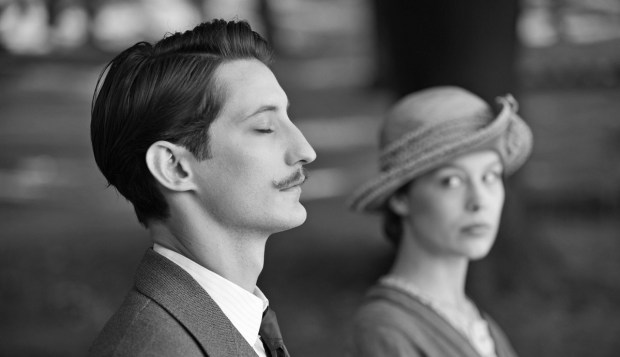
Anna’s life has ended before it’s even begun. Like so many young men from her small German town, her fiancé Frantz never came home from the war. Widowed without ever having been a wife, she lives with his bereaved parents, two good old people who love her like their own daughter. Every day she goes to tend Frantz’s grave in the cemetery – an empty grave, for his body was never identified – and it’s here, one day, that she sees a stranger standing in front of Frantz’s headstone. A tall young man, who leaves a flower on Frantz’s grave and walks away with tears in his eyes. Anna is intrigued. Who is this young man? How does he know Frantz? And can he give them any of the answers they so desperately seek? With the emotional intensity of a chamber piece, this film is a very moving meditation on grief, loss, guilt and learning to live again.

Continue reading

The Girl in the Tower (2017): Katherine Arden

★★★★

Winternight: Book II

Hot on the heels of The Bear and the Nightingale comes its sequel: another compelling slice of Russian-flavoured fantasy, prickling with ice and magic. Our heroine Vasya has saved the villagers of Lesnaya Zemlya from an evil far greater than that of the Devil the priests have taught them to fear, and far older than the icons and crosses of their churches. Yet her reward is scorn, distrust and hostility: a reputation as a witch. And so her eyes turn to the horizon, to the wider world she has craved for so long. With her incomparable horse Solovey, she sets out – but not before her path leads her back to a little house in a fir-grove in the forest, where the frost-demon Morozko waits for her.

Continue reading

Self Made Man (2006): Norah Vincent

★★★

My Year Disguised as a Man

As long-term readers of this blog will know, I’m very interested in gender as a concept. How do we internalise society’s expectations of gender? How can we tackle gender imbalance in the workplace and the boardroom? Is gender itself innate or created? How can we reinvent our own gender, and with what level of success? When I heard about this book, it promised to answer another question that niggles with me a great deal and which, perhaps, I’ll never really know the answer to. Is there really that much difference between men and women? Norah Vincent, a New York journalist best described as ‘fearless’, decides to investigate this question. Rather than simply collecting information from interviews, she goes one better: she decides that, for a whole year, she will join her subjects, dressing, socialising, living and dating as a man. It’s a daring project and fascinating to read about, even if I have some misgivings about her methods.

Continue reading

Jamilia (1958): Chingiz Aïtmatov

★★★½

One thing I wanted to do this year, which I haven’t really managed, is to read more novels from other cultures. Perhaps that’s something I can pick up again in the New Year. I want to use fiction as a way to understand how people from other parts of the world think; the principles they live by; and the challenges they face. And, more than that, I hope to find further proof for my belief that we are all, fundamentally, much the same, no matter where we come from. No matter the language we speak, the faith we follow or the colour of our skin, there are certain common experiences that affect us all. Hope, ambition, fear, loss, and love above all. This novella by the celebrated Kyrgyz author Chingiz Aïtmatov, who died in 2008, focuses in on this last, for a brief but beautiful story of star-crossed lovers in the shadow of the steppes.

Continue reading

The Absolutist (2011): John Boyne

★★★★

It is 1919 and Tristan Sadler arrives in Norwich to meet Marian Bancroft, the sister of his friend and comrade Will Bancroft. Tristan has come to return the letters Marian wrote to her brother, which he has kept ever since Will’s death. And yet he hasn’t made this journey solely for the sake of restoring a piece of her family history. There are things Tristan needs to say; amends he needs to make. Will Bancroft didn’t die in action, but was shot by a firing squad of his own peers, hauled up on charges of cowardice after proclaiming himself an ‘absolutist’ – the firmest kind of conscientious objector. Tristan needs to tell Marian that her brother wasn’t a coward; but he also hopes, in meeting her, to find some closure for his own traumatic experiences on the Western Front.

Continue reading

L’Incoronazione di Poppea (1643): Claudio Monteverdi

Monteverdi: L'Incoronazione di Poppea (Berlin)

★★★★

(Berlin Staatsoper, conducted by Diego Fasolis, 13 December 2017)

Berlin’s Staatsoper has just reopened after a seven-year refurbishment. On Wednesday, the house was sold out as people gathered to celebrate its freshly gilded finery. And what was on the menu for the grand reopening? Not a safe and predictable opera – a Tosca or a Bohème – but a dose of Roman passion and psychosis from the 17th century. With only three performances (this was the last, until its projected revival next summer), this Poppea felt intense, fresh and daring. It wasn’t without its wobbles, but it featured some very strong casting and offered a compelling picture of a court in thrall to an egotistical, unpredictable sun king. Unsurprisingly, I’ve got slightly carried away with the length of this post, so you may wish to furnish yourself with a cup of tea before starting. There are, however, some very pretty pictures.

Continue reading

A Search for the King (1950): Gore Vidal

★★½

Some years ago, I read and enjoyed Gore Vidal’s Julian, which tells the story of the young pagan who becomes Emperor in a post-Constantine, Christian world. Since then, I’ve been keen to try more of his historical fiction and this book was the first to come into my hands. I had high hopes for it, as I’ve always been fascinated by Richard the Lionheart – probably due to my childhood fondness for Robin Hood stories: Richard’s own record as an indifferent King of England certainly doesn’t do him any favours. Vidal focuses on a particular episode from Richard’s life: the King’s famous capture in Austria on his return from the Crusades, and the faithful (and probably fictional) quest of Richard’s troubadour Blondel, who sets out to find his master’s prison, armed only with his viol, his voice and a good deal of faith.

Continue reading

Holy Fools (2003): Joanne Harris

★★★½

For five years, Juliette has lived in peaceful isolation at the convent of Sainte Marie-de-la-Mer, on the island of Noirs Moustiers (modern Noirmoutier) in eastern France. Within the abbey walls, she has reinvented herself as Soeur Auguste, a young widow who has sought sanctuary with her little girl Fleur. None of her sisters knows her true identity. But others do, and Fate – or God – works in mysterious ways. When the old Abbess dies, her replacement arrives with a confessor in tow: a glamorous, silver-tongued, charismatic man who Juliette knows, only too well. Against her will, she finds herself being drawn back into a dangerous game she thought she’d escaped long ago… for her dark nemesis is a gambler and this time he is prepared to play with sanity, faith and even lives at stake.

Continue reading

Eaters of the Dead (1976): Michael Crichton

★★★★

We all know not to judge books by their covers (even if we still do it), and this is a very good example of why it can be dangerous to do so. Both title and cover suggest this is a gruesome horror story. A quick glance at online reviews shows that some readers have been (legitimately) baffled to find themselves, instead, reading a pastiche of an academic text edition, complete with introduction, footnotes and bibliography. They’ve responded with low ratings and that’s a shame, because this novel is a daring blend of fact and fiction: a pseudo-intellectual sleight of hand which playfully offers a historical ‘source’ for the greatest of Western medieval legends: Beowulf.

Continue reading